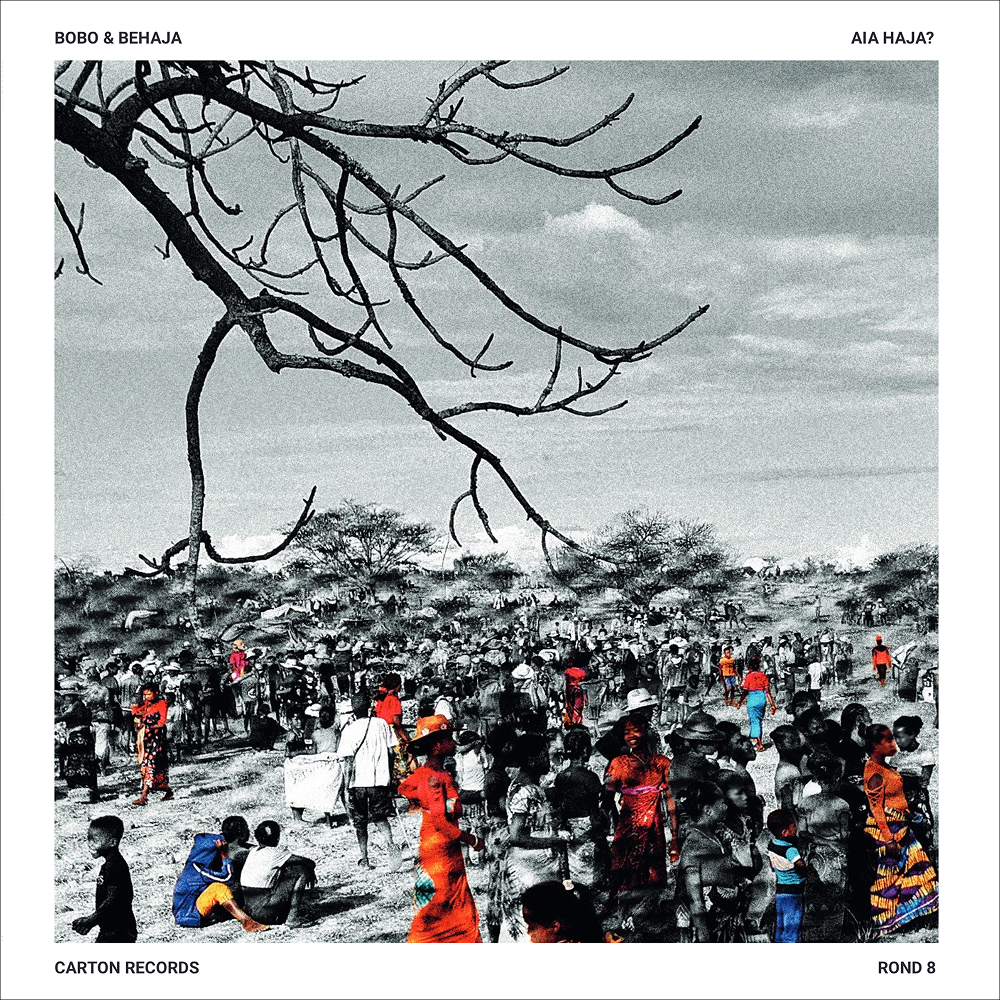
bobo & behaja | aia haja?
AIA HAJA? WHERE IS BEHAJA?
isolated from the rest of the group at the front of the plane taking us from budapest to zurich, behaja left without waiting for us, confidently following a group of travellers who had gone to catch their connecting flight. lost in switzerland's largest airport, he had no phone and he speaks neither french, english nor german.
after an hour and a half of searching and several public announcements to the thousands of travellers, the airport police, initially uncooperative, finally found him at the end of a corridor. finally reunited, we managed to catch the transfer to paris at the last minute, but some of the suitcases – checked in hastily – were loaded into the hold of a different plane.
a few days later, we set off to record our first album, deprived of much of our equipment – horn loudspeakers, karaoke amplifiers and homemade effects pedals that reproduce the sonorities of the “bal-poussière” ceremonies of south-western madagascar – which the airline sent us after a week's wait.
so it was only during the last two days in the studio that the conditions were right for recording the tracks for this album.
the repertoire, largely created in madagascar and then performed on stage during a european tour of some thirty concerts, is based on the new rhythms, structures, instrumental and vocal techniques of contemporary tsapiky, of which behaja is one of the most emblematic musicians.
ekaly | vocals
maxime bobo | alto sax
behaja | guitar
françois rosenfeld | bass
gérard rakotoniaina | drums
credits
recorded at la chèvrerie in azé by antoine serreau
mixed by antoine serreau
mastering by peter deimel
artwork by marylou gabriel
created in madagascar and recorded in two days after a few mishaps during a european tour – notably the loss of guitarist behaja (hence the album title) at zurich airport – the repertoire on this album is inspired by the new sounds of contemporary malagasy tsapiky.
as an extension of the collaboration between electric vocuhila and the musicians of behaja, a leading group in modern tsapiky, this new formation creates a unique combination with the saxophone, blending tsapiky, (free) jazz, and rock.
© Carton records
released february 20, 2026
digital | cd | vinyle - ref cat rond 8
1 parepare 08:14
2 rodobey 05:35
3 kabosy 06:48
4 digital & CD only: tantely male zay 08:34
5 handeha hihisa zaho baba 07:06
6 rafoza manday tandra 05:57
7 karioke menamaso 07:23
Lucia Gadau meets Maxime Bobo, the free-jazz-loving French saxophonist who, with Malagasy guitarist Behaja, is carrying Madagascar’s ceremonial tsapiky music to the world
Pestra ritmika in navidezno nenadzorovani melodični prijemi, ki v sebi nosijo dobršno mero spretnosti izvedbe, so nepogrešljive sestavine glasbe, ki na poslušalsko uho v nemalo primerih delujejo z unikatnim izkupičkom ob boku. »Oh, ta glasba me pa kar spravi v nek trans!« bi brez težav slišali tudi v kontekstu albuma kvinteta Bobo & Behaja z naslovom Aia Haja?, ki ga obravnavamo v tokratni Tolpi bumov. Toda pri obravnavi glasbe francosko-malgaške zasedbe je smotrneje uporabiti kakšne bolj podkrepljene pristope. Subjektivno dojemanje je resnična stvar, in širši množici, ki ni nujno ciljna, morda raje le številčnejša, omenjeni obljubljeni trans pridoda dovolj – dovolj, da se bo nekdo kljub nepoznavanju konteksta glasbe ali pa osnovnih vprašanj, ki jih ta odpira, vendarle odločil za nakup vstopnice za obisk koncerta.
Cette semaine dans votre selecta : un artiste afro-américain d'ascendance jamaïcaine qui mêle avec une élégance folle R&B, jazz et rap et fait de la vulnérabilité une force ; un festival de « musiques d'un monde en mouvement » où tsapiky malgache, chants kurdes et MPB se rencontrent. Et « l'histoire d'un live » du groupe de reggae-roots californien Groundation.
Les rythmes frénétiques du tsapiky malgache de Bobo & Behaja rivalisent de fougue avec les punchlines désarmantes de la rappeuse franco-camerounaise Uzi Freyja.
Titres interprétés au grand studio :
- Anotsy Live RFI
- Tantely Male Zay, extrait de l'album
- Lahy Tsy Niha Live RFI.
[…] Music shaped by airports, accidents and the stubborn will to play. In the process, tsapiky is stretched into something both fiercely traditional and restlessly novel.
Cette semaine, BPM vous emmène à Ljubljana, au cœur du MENT Festival, là où les traditions se réinventent et où les scènes indépendantes dialoguent au-delà des frontières. Avec aussi : une énergie hybride venue d’Afrique du Sud, de l'électro solidaire de l’Ukraine, le tsapiky incandescent du Sud-Ouest malgache et, dans « l’Histoire d’un live », une légende brésilienne, Antonio Carlos Jobim, qui fait tomber une pluie tropicale sur Montréal.
Le quintette s’articule autour de ses deux leaders éponymes : le Fançais Maxime Bobo, saxophoniste au sein des groupes Electric Vocuhila et Mitsaitsaiky, et le Malgache Behaja, prodige de la guitare électrique originaire de Sakaraha, dans le sud-ouest de l’île. Avec leur disque Aia Haja ?, ils contribuent à renouveler un genre en perpétuelle mutation, certes, mais jusqu’alors peu coutumier des cuivres. De cette alliance singulière entre cordes et pistons naît une énergie inédite, flirtant avec le rock et le free jazz.
Terrific and gripping jazz with touches of Afrobeat in its leaping rhythms makes for a joyous ride.
Un quintet franco-malgache, au carrefour des couleurs orientales et occidentales, c’est Bobo et Behaja. Un voyage où les surprises s’invitent sans se faire attendre… Des sonorités délirantes, aux rythmes trépidants, la musique nous emporte dans un tourbillon mélodieux, un mouvement indomptable.
These are Malagasy virtuosos bouncing off each other’s impulses. I’ve never heard anything like it. —Matt Mitchell
THE EDITED PRESS RELEASE: “Isolated from the rest of the group at the front of the plane taking us from Budapest to Zurich, Behaja left without waiting for us, confidently following a group of travellers who had gone to catch their connecting flight,” recalls one of the Franco-Malagasy guitarist’s bandmates — a list that includes vocalist Ekaly, also saxophonist Maxime Bobo, bassist François Rosenfeld and drummer Gérard Rakotoniaina.
Tous les mois, le critique musical Sophian Fanen, du site Les Jours, sélectionne 5 titres. Pour février, les élus sont :
- Nilza Costa, Oxum, tiré de l'album Cantigas (Brutture Moderne, 2026)
- Momoko Gill, No Others, tiré de l'album Momoko (Strut Records, 2026)
- Danyl, Ya Habiba, tiré de l'album Zmig (Structure, 2026)
- Bobo & Behaja, Parepare, tiré de l'album Aia Haja? (Carton Records, 2026)
- Sumé, Piffiit Nutaat, tiré de l'album Sumut (ULO, 1973).
Next Week in Music | February 16-22 • The Short List: 21 Titles You Want to Hear (Part 1)
Enjoy an episode that revolves around projects that forge compelling bridges between jazz and African music, from Benin to Madagascar, Mali, Senegal and Tunisia.
Happy listening!
Radio Free Brooklyn's "Mondo Jazz" (Host: Ludovico Granvassu)
December, 17, 2022 10:00 PM–12:00 AM
As has long been the case, the Mundofonías team attended the annual meeting of WOMEX, one of the largest events related to root musics on the planet that is held each year in a different city. In 2025 it took place in Tampere, Finland, and from there we bring impressions of some memorable concerts which we recall and which make us travel through Mali, Tanzania, Madagascar, Serbia, Taiwan and Mauritania among other destinations. We also share the conversations we had with Maxime Bobo, co-promoter of the Franco-Malagasy project Bobo & Behaja, and with the Taiwanese musicians of 3Peoplemusic. We listen to the winner of the Artist Award, the Mauritanian Noura Mint Seymali, and we also comment on the refusal of the Professional Excellence Award by the creators of the Syrian Cassettes Archives, listening to some of the music recovered and compiled in this initiative.