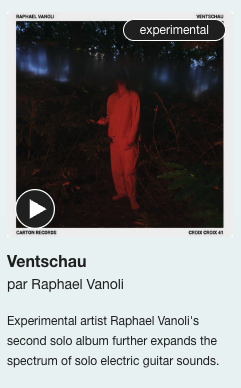
société étrange | heat @ o's place jazz magazine (us)

Société Étrange    -    Heat 71

O's Notes: Societe Etrange is a French trio with Antoine Bellini (electronics), Romain Hervault (b) and Jonathan Grandcollot (d). We are immediately greeted by the pumping beats of a club scene. The krauts music is composed of simple electronic beats revolving around a heavy bass line with a hypnotic, airy feel. There are hints of reggae on “Soleil Lourd”. The mysterious “Place Saint Bruno”, “Fenetre Sur”, and “Chamber Dress” are highlights in this roots music revival.

antoine ferris | la nèu ft. louie z @ sleep dose on radio bandito (it)

Wednesday 10 June 2026, from 10 pm on the non-frequencies of radiobandito.it, Sleep Dose #170 (Vita Cortese).

Lying there idyllically, I try to prolong this timelessness of satisfying laziness indefinitely, although one step beyond it all swirls, if only in thought, from the song of blackbirds to the sinister hum of an armed drone.

I often wonder what the faces of the people who control them remotely look like; all those hours spent practising, whilst in the breaks between a simulation and a real attack (but where is the difference from their point of view?) they smile, joke and sip coffee, trying to make sense of their own behaviour as insect killers.

We dance from star to star, whilst everything drifts like a wreck still dimly lit, but already at the mercy of the current.

antoine ferris | [kaaarst] @ silence and sound

Antoine Ferris

[KAAARST]

(Carton Records)

Bassiste et contrebassiste, actif au sein de plusieurs formations, Antoine Ferris est aussi un aventurier de son instrument, le détournant de son usage traditionnel pour le catapulter dans les sphères de l’expérimentation à coups de pédales d’effets, appréhendant la musique de manière peu conventionnelle, où les glitches et les bruits blancs forment des zones de ruptures au bord de l’implosion.

Avec [KAAARST] il déboule dans des espaces glissants, où les contours d’une pop libérée de tout artifice se greffe au sein de son univers grésillant, histoire de nous faire prendre toute la mesure de son incroyable talent, à l’image des titres La Nèu feat. Louie Z ou Shame’s Coming feat. Natacha Kanga.

Antoine Ferris n’est pas sans évoquer certains artistes signés chez Editions Mego, de par sa faculté à redessiner les contours d’une scène électronique expérimentale aux agitations soniques enthousiasmantes. Un album joueur aux textures sauvages qui nous prend aux tympans pour ne plus quitter. Implacable.

Roland Torres

Link: cartonrecords.bandcamp.com/album/kaaarst

choolers division @ bandcamp daily

How Artists With Disabilities Are Blazing New Musical Frontiers

By Jimmy Trash · Illustration by Amy Moss · May 29, 2026

“We call this ‘hurry up and wait.’ There is always a lot of waiting with us!” explains Michelle Hall, vocalist for the “weird-pop” group The Sisters of Invention. Hall is waiting to record her vocals in the studio at Tutti Arts, a multi-arts organization for disabled and neurodivergent artists in Brighton, South Australia. The band’s manager Bree Tranter is currently in the booth, conducting a lead vocal take with Aimee Crathern, while Annika Hooper, Hall, and Caroline Hardy work on some last-minute lyric adjustments in the adjacent room.

The Sisters are just one of a growing number of bands supported by inclusive, professional art and cultural productions including artists with and without disabilities. In addition to The Sisters, Tutti is also home to Quirkestra, an ambitious, experimental big band developed by Mat Morison of My Cherie and SlowMango. (Full disclosure: the author of this piece was also a member of this band). The Quirkestra is made up of 13 musicians representing a broad spectrum of learning and physical disabilities who meet once a week for writing, recording, and rehearsing with a dedicated staff of musician-careworkers. Along with developing a band structure where everyone’s abilities are utilized, Morrison also co-creates accessible instruments alongside the artists.

“I’ll always start with a strength or an interest of the person that I’m making the instrument for,” Morrison says. “If the artist is really good at dancing and moving their feet, the accessible instrument might take the form of a platform where their foot movements create musical sounds. Or if they’re into magic, their accessible instrument might take the form of a wand.” Wielding that wand is musician and artist Grace Lam. “It allowed me to grow in confidence by being free to experiment, and write my life stories into songs,” she says. “Learning to vocalize lyrics helped me to not be harsh on [my singing voice].”

Hamburg act Station 17 are arguably one of the earliest—and most prolific—examples of bands like The Sisters and The Quirkestra. Station 17 works inside Hamburg’s Barner 16 network, a collective of bands of a similar makeup. Station 17 has been releasing albums since 1989, collaborating with icons like Michael Rother, Holger Czukay, and FM Einheit, as well as other notable members of the German wave and experimental scenes. Nils Kempen, who has been the group’s guitar player since 2014, describes a similar process at Barner16 to the work being done at Tutti Arts. “On our rehearsal days, we write songs or prepare for concerts,” he says. “Anyone can contribute ideas for new songs. We try to consider all ideas, but they have to be compelling enough to generate a collective interest in pursuing them further. In this way, a song can gradually emerge from a melody, phrase, or rhythm. We try to avoid situations that seem like coaching or teaching.”

“We want to utilize the talents that each band member brings,” he continues. “We don’t want to compensate for perceived ‘weaknesses’ or ‘flaws’ of individual musicians. Rather, we try to incorporate them if they align with our shared artistic intention.” For Kempen, the song “20,000 Miles Under the Moon” is the perfect reflection of Station 17’s method of working. “We improvised a lot,” he says. “The structure presented itself beautifully—almost by itself.”

The Semi-Modulars are an analog synthesizer band operating inside the Texas School for the Blind and Visually Impaired. Their records exude excitement, sinewave explorations interlaced with video-game bangers, making for an ecstatic combination. After an introduction to the basics of synthesizers and sound design, students begin a year-long course, choosing their synth and eventually recording and performing.

“Each student is assigned a synthesizer based on their musical strengths,” says instructor Dan Butler. “For example, the more musically advanced students will play a polyphonic synth. Students with a strong sense of rhythm might play a monophonic bass synth. Students that aren’t as adept at playing parts on a keyboard will work with semi-modular synths and effects to create sounds and textures in real time over the rest of the band. We arrange and rehearse as many songs as we can in the time allotted.”

“I was dreaming when I was small about being in a band and I finally got to have the experience,” Says current Texas student Alex Maradiaga. “I like that people enjoy our music and they have fun at the concerts.” He’s especially fond of the songs “After You Leave” and “Texas Misses You.” “Both are beautiful songs and are very sentimental to me. When I feel sad, I like emotional songs. I wrote both of those songs when I was feeling sad, and it made me feel a little bit better”.

Stefan Neville began making music as a teenager in Hamilton/Kirikiriroa, New Zealand in the early 1990s. Throughout the ‘00s, his band Pumice (with Jon Arcus) toured the world, playing with the crème de la crème of noisy art brut subculture before starting to work in the disability support sector in 2010. Inspired by his appreciation for legendary Argentinian band Reynols (“transcendental imagination and magic is in everything they do”), Neville began to hold free music-making sessions, which evolved into recordings and live gigs at festivals and local events. This work produced bands like the haunting The Talent and Michael & Daniel as well as session recordings available on his own label.

“My background in music is all self-taught and DIY,” Neville says. “I wanted to model that for people and show that anyone can make music. And it’s not just in a therapeutic model, where [the music-making is] in the moment. We can record it, share it with friends, we can release it, we can do a concert. It’s not just making music, but amplifying the parts that can be social opportunities—meeting people because they liked your concert. The rich life I’ve had because I made music, I thought, ‘I can help people have the same opportunities.’”

Neville moved his work to the art-therapy workshops of Māpura Studios in Tamaki Makaurau (Auckland) where he amassed 12 years worth of recordings, essentially creating a giant database of imaginary worlds, soundscapes, and alternative song structures. Among them: The epileptic-ethno-poetic project Artilepsy and PomPom, who were featured in the book Perfect Sound Forever by the English comedian James Acaster. (He posited that 2017 was the best year for music, and that PomPom’s album was evidence of this.)

The Māpura Music group is featured on the double-LP compilation We Are the World, which consists of international artists and was released by the French label Sonic Protest, and Neville recently released Rescued Speech Songs, working with autistic storyteller Indika Gamage-Mendis who had been participating in the Māpura Music Project.

As Station 17’s Kempen puts it, performing with the band helped him understand “the benefits of consuming art when one manages to break free from learned and common conventions and gain access to other perspectives—not just mainstream art, but also, aesthetic, highly ‘regulated’ art within subcultural contexts.” In other words, both sides of the equation help one another creatively and socially, resulting in music that is thrilling to listen to. This article just scratches the surface, here are more artists doing incredible stuff worth checking out:

Two other members of the Barner 16 project, both the amazing Slowi Chrizz—who have created a particularly dope film clip—and kUNDEkÖNIG both indulge in the trashy flavor of punk that is characteristic of the Hamburg scene.

Heart ‘n Soul in London produces and promotes artists like the delightful dub electro singer D.M.S., as well as the late Lizzie Emeh, a soul legend and a genuine inspiration to many artists around the world.

Dean Rodney Jr is a surreal, dancefloor-filler electroboogie artist whose humor and intensity are unmatched, and The Gate releases dubby tapes packed with incredible, Bill Laswell-esque explorations.

Hardcore French rappers Choolers Division, with their live band and aggressive delivery, are infectious and fresh as hell. Bands like rowdy punks Wild Classical Music Ensemble can be found on the Sonic Protest compilations, while the more proggy and hypnotic DNA? AND? are only a slice of the good stuff on Norwegian label Sanntids Musikk.

frantx | ltb @ wfmu (us)

Anima Mundi with Chinn: Playlist from May 31, 2026

View chinn's profile

The world is bound with secret knots. Hermetic meditations on the weird, beautiful, ancient, terrifying and/or confusing, with music! Chunky New Age, contemporary classical, cryptic Western, avant pop, shimmery jams, weird noises, plus old favorites and who knows what else. Everyday magic; magic every day.

Sunday Midnight - 3am (EDT) | On WFMU | 91.1, 90.1, 91.9 FM & wfmu.org

frantx | idutydu @ pointbreak (fr)

idutydu,
f r a n t x 
— chronique


par Selma Namata Doyen
photo © Eudes Lemare

line-up

Fanny Meteier tuba, voix, toy synth
Andrea Giordano voix, électronique, mélodica
Pierre Pradier guitares, voix
Marco Luparia batterie, électronique, voix

carton records
standard in-fi

mai 2026

Le titre est déjà un petit accident administratif : IDUTYDU (I Didn’t Understand That You Didn’t Understand). On pourrait croire à un échange de mails devenu incontrôlable ou à un bug de sous-titres automatiques. En réalité, c’est un résumé assez exact du disque : une musique où les informations arrivent trop vite, changent de fonction en cours de route, puis reviennent déguisées comme si de rien n’était.
Chez FRANTX, les instruments n’ont manifestement pas signé pour les postes qu’on leur avait promis. Le tuba ne sonne presque jamais tuba : il souffle, compresse, parasite, gonfle les contours du son jusqu’à ressembler tantôt à un moteur fatigué, tantôt à une nappe électronique qui aurait mangé trop de gravier. La batterie ne marque pas le temps, elle le découpe en tranches inégales et les redistribue sans prévenir. Les guitares choisissent de ne pas choisir entre riff, texture, objet contondant et meuble sonore. Quant aux voix, elles circulent dans le mix comme des personnages secondaires qui auraient pris le contrôle du scénario. Le plus amusant, c’est que cette organisation apparemment anarchique est d’une précision presque vexante. Les morceaux tiennent par gestion des densités, déplacements de registres, ruptures calibrées et un travail très fin sur la saturation. Rien ne déborde par accident.
PINGU TRAUMA avance comme 4 membres d’un groupe qui se chamailleraient en jouant, tout en restant étonnamment d’accord. ORGASMIC KITCHEN pousse encore plus loin cette économie du faux chaos : motifs abandonnés, retours absurdes, coupes sèches, puis soudain un passage parfaitement construit — comme si quelqu’un avait rangé le bazar pendant qu’on regardait ailleurs Et puis il y a BANANA PHONE BOI, qui étire enfin le temps. Les couches s’empilent : souffles, saturation, électronique, voix, percussion, timbres qui se frottent sans politesse excessive. Là, le disque révèle son vrai talent : produire énormément de matière sans jamais fabriquer de bouillie.
IDUTYDU pourrait donner parfois l’impression qu’un ensemble de musique contemporaine aurait accidentellement surfé sur trop de forums, téléchargé trop de pop et avalé un peu trop de caféine. Trop ? Définitivement non. Ce disque groove souvent et jamais trop. Avec beaucoup plus de tenue qu’on pourrait lui en accorder.

frantx @ citizen jazz (fr)

Banlieues Bleues trace de nouveaux chemins

Le 31 mars, à la Dynamo de Pantin, Banlieues Bleues ouvrait une soirée placée sous le signe du risque et de l’invention avec TERRINE, FRANTX et Rojin Sharafi. Trois propositions pour « tracer de nouveaux chemins », lisait-on dans l’édito du festival, et c’est bien cette ligne qui a dessiné la soirée, faite de tensions, de matières instables et de formes qui refusent de se laisser domestiquer.

[…]
FRANTX allait ensuite déplacer la soirée vers un autre type de tension, plus vocale, plus politique, plus fragmentée aussi. Le quatuor franco-italien donne à voir un monde en crise, tantôt hostile, tantôt désespéré ou absurde : Fanny Meteier en keffieh donne le ton avec un discours engagé, Andrea Giordano prend le relais, masquée par un carré dentelé, voix distordue jusqu’à devenir presque sans visage, mais jamais totalement déshumanisée. Le groupe, né de croisements entre improvisation, musique concrète, pop mutante et noise-glitch, travaille le collage comme une dramaturgie du heurt.

La musique avance par à-coups, par surgissements, par motifs qui se défont aussitôt qu’ils se stabilisent. On passe du coq à l’âne, mais sans gratuité : cette instabilité semble constitutive du projet, comme si chaque musicien testait en permanence la résistance du groupe, ses limites de cohésion, ses seuils de chaos. Certaines séquences, notamment celles qui jouent sur les aigus de la guitare et des clochettes dans des textures micropolyphoniques où se répondent Pierre Pradier et Marco Luparia, ouvrent de très beaux espaces de suspension.
Et puis l’humour, indispensable antidote pour ce monde cassé : « celle-là, c’est la chanson du camping, je vous préviens », annonce la tubiste avant le dernier titre, en admettant son émotion à se présenter à Banlieues Bleues en tant que « fille du 93 ». Ce décalage entre la gravité du matériau et la simplicité du rapport au public donne au set une humanité particulière : « Fly Communication » fait sentir avec une lucidité ironique les malentendus et les tensions du collectif transnational comme partie intégrante de leur musique. C’est ce titre qui clôt leur premier album IDUTYDU, dont la sortie est prévue le 22 mai 2026.

[…]

tatiana paris | thalle @ off topic (it)

Tatiana Paris – Thalle (Carton Records, 2025)

21 Maggio 2026

3–5 minuti

R E C E N S I O N E

Recensione di Luca Onyricon Giglio

Di ritorno dopo il suo esordio Gibbon del 2022, Tatiana Paris pubblica per la francese Carton Record il suo secondo lavoro Thalle e non presenta un disco, bensì una sorta di organismo vivente. Un organismo che tramite una fotosintesi mirata ci nutre liberando nell’aria architetture nebulose, sulle quali la musicista interviene. Piante senza radici né foglie, suggestioni dissonanti e organiche prendono vita dalla natura come corpi vegetali privi di tessuti vascolari complessi.
Alla vista di questa copertina, con reminiscenze a “Still Life” dei Van Der Graaf Generator, è il tallo a fungere da illustrazione, e in definitiva evoca la musica suonata da quest’artista, un album di dieci composizioni, intitolate senza lettere maiuscole, che si dispiegano senza soluzione di continuità in 45 minuti.

Un viaggio sorprendente, a tratti selvaggio, in cui Tatiana suona la chitarra preparata, accompagnata da sintetizzatori modulari, oggetti, un vecchio “acousmonium hertziano” (un vecchio flauto dolce), un organo e, occasionalmente, una voce eterea con autotune. Questa musica cinematografica sembra muoversi, fondersi con l’ambiente sottomarino. Si immaginano le piante ondeggiare al ritmo di una corrente liquida.

A comporre Thalle sono nove frammenti sonori che, analizzati al microscopio, svelano una struttura complessa e imprevedibile, il suo incedere oscilla fra strumentali cheti ed arrangiamenti acustico-rumoristi. Ricorda vagamente quell’onda magica e acustica che spesso accompagnava le uscite Tomlab, una sensibilità che di questi tempi si vede rifiorire anche nelle produzioni di aus e di Flau Records ad esempio, anche se qui, tramite il cantato, l’approccio vira in direzione di qualcosa di più intimo ed orecchiabile. I brani sembrano formarsi per genesi biologica, quasi come il corallo in copertina, molecola dopo molecola in forme e colori delicati. La chitarra boccheggia fra un respiro e l’altro, placida, a dare grumi di suono che a tratti potrebbero ricordare la magia dei Gastr Del Sol in trasparenza, quasi come se invece di spartiti Tatiana suonasse direttamente degli erbari, dando il via a piccoli caos appena percettibili, come minute forme di vita sotto il vetrino di un microscopio. A tratti la musica diventa solenne, soprattutto quando l’organo di Rachel Langlais fa da collante all’equilibrio elettroacustico a base di field recording, synth modulari, drone music, nastri registrati e oggetti casuali che producono suoni concreti.

Di tanta maestria e ingegno si nutrono i due capitoli drone ambient che prendono nome dal titolo dell’album, thalle I e thalle II, dove la magia si fa ieratica e immobile, quasi ci costringesse a cercarne una presenza con lo sguardo oltre che con l’udito. Il ritorno della voce nella conclusiva salluit e l’apparente contrasto armonico di avril sono due facce della stessa medaglia (tutti gli interventi vocali sono tratti da poemi di Pierrick Pagé, Joséphine Bacon e Marie Andrée Gill), un commiato crepitante e misterioso, un breve attimo di crescita e di luce condivisa fra esseri in continua evoluzione e cambiamento, un miscuglio di sperimentazione e consapevolezza tecnica che anima tutta l’opera di Tatiana Paris e che in Thalle trova la summa per una sintesi sottrattiva ammirevole.

Carton Records ha il potere di attrarci con l’ignoto, attraverso il prisma di audaci avventure musicali. Ad ogni uscita, ci ritroviamo talvolta immersi nel mondo minerale o travolti dai meandri di qualcosa di più organico. Con Thalle si raggiunge una sorta di apogeo, un’opera unica e immutabile, capace di trascinarci in un disagio sensuale sonoro (intro) che funge sia da esca sia, soprattutto, da processione verso un altare ricoperto da questo tallo, che si dispiega con un distacco quasi soprannaturale. Abbondante e pervasiva, la musica traccia un percorso di eccellenza, liberandosi dai sentieri battuti per trasmettere al meglio ciò che l’evanescenza può produrre quando non è la radice della futilità.

Thalle è la perfetta traduzione musicale della parola emozione, una ballata senza tempo, un tuffo in ciò che non possiamo immaginare, una frontiera che risponde alla possibilità che l’infinito possa avere una fine. Tra paesaggi sonori e rumori maestosi che offrono evasione, Thalle è un volo commovente, quasi mistico, eppure saldamente radicato alla terra, con radici che si protendono verso il cielo vaporizzandosi in una bellezza straordinaria.

frantx | idutydu @ red hook star-revue

Music: Wiggly Air – Deafkids, My Heart, An Inverted Flame, it foot, it ears, FRANTX, Tom Waits and Massive Attack

Electro blipmares from Paris. The French/Italian four-piece FRANTX sound decidedly more contemporary than does it foot, it ears, but are similarly disorienting, likely because I don’t speak French. They’re super-cute and vaguely anxious, technicolor techno masking what seems to be a disaffected detachment. All four members provide (processed) vocals and synth textures on their debut IDUTYDU (LP, download from Carton Records May 22), although there’s also occasional acoustic guitar and tuba as well. A slow chaos ensues, as on “Pingu Trauma,” in which a robot sing-a-long interrupts what sounds like a cartoon ensconced in a blanket of scorn. There are little melodies at times, but there’s not often much going on in song form. Still, it manages to keep a poppish feel aloft, like comic sans illbient. The lyrics might point a different direction, but that said, the album’s final track, “Fly Communication,” delivered in accented English, is about our inability to converse with bugs, even when they say they understand. Communication is overrated.