Posts in review
générique mardi | diane @ muzzart (fr)

Générique Mardi « Diane » (Carpaccio Cathédrale/Carton Records & La République des Granges, 6 novembre 2026)

Will Dum11/11/2026

Facebook
Twitter
Pinterest

Share

Générique Mardi est né fin 2022 à Toulouse, de la rencontre entre Juliette Pym et Bonella Holloway. Rebecca (chez AB Records et Cœur sur Toi), en 2024, posait un premier jalon singulier. Diane l’est tout autant, au « je » de l’opus précédent il substitue le « tu ». Désirs promus il s’inscrit dans une trame synth où sont évoqués affirmation de soi, pièges amoureux et relations toxiques, colère comme moteur d’empouvoirement, sororité, désir sexuel (assouvi ou non), excès de la fête et de la drogue. Tout un programme que The Flood instaure sur des tonalités post-punk rapides et rachitiques, dotées de bruits froids. Le chant est blanc, me voilà de suite attrapé. Boundaries, dépaysant de par ses sons, flirte avec le disco mais attention, version réfrigérée! Générique Mardi, ce mercredi, s’invite dans mes rayons. Make Believe confirme l’illusion, lent et sobre. On y croit. La paire offre un panel animé, sans ennui aucun. Toxicité, dont rien que le nom est d’actualité, livre un électro chaloupée, stellaire, du plus bel effet.

Là encore on s’y laisse prendre, voguant sur des ritournelles allégoriques. La huitaine séduit dans le gris, My Inner Slut l’agite de son rythme sec. Les basses groovent, le synth danse version 80’s et ouais Biggy! Diane, après ceci, largue lui aussi des effluves délectables. C’est dans le minimal, bien rempli, que s’exprime Générique Mardi. Sister Rivalry ondule, aérien tout autant que virevoltant. Il se passe de chant, pas moins concluant. Ah beh nan comme dirait l’autre, l’Anglais dans le texte se pointe et va de pair avec des nappes racées. Il revient à Yellow Tiles, dans un saccadé vite entrainant, de conclure entre spatialité et répétition de motifs décisifs. Je suis pour ma part preneur, grisé par l’approche de ces deux Dames du sud.

LIKΣN | la toute multiple @ radiohörer (de)

Release Tipp: Highlights Oktober 29 / Teil 2 oder 11 aus 21

10. November 2026

Musik von Thomas Brinkmann, Vitor Joaquim,Jo David Meyer Lysne und Peder Simonsen, LIKΣN, Shovel Dance Collective, Emily A. Sprague, Unni Løvlid und Marianne Baudouin Lie, Steven Hesss & Rutger Zuydervelt, Jeremy Young, Isik Kural.

Auch auf die Gefahr hin, mich zu wiederholen: Die Menge der Veröffentlichungen ist nach wie vor so groß, dass es unmöglich ist, alles zu hören. Dass einiges davon zu Unrecht nicht genannt wird, ist nicht auszuschließen. Und was auch nicht ganz unwichtig ist: Es ist meine Auswahl. Das möchte ich hier noch einmal betonen.

Die nachfolgenden elf Releases sind auf jeden Fall und auf ihre eigene Weise etwas Besonderes. Sei es der neue Geist der irischen Folklore des Shovel Dance Collective. Die versponnenen Lieder von Emily A. Sprague oder die Lieder aus dem „Svartebok” („Schwarzes Buch”), einem Zauberbuch von Unni Løvlid und Marianne Baudouin Lie, das auf geheimnisvolle Weise den Weg zu mir gefunden hat. Unerhörtes von LIKΣN und Jeremy Young. Und die Highlights: Thomas Brinkmann, Vitor Joaquim, Jo David Meyer Lysne und Peder Simonsen.

Jede dieser Veröffentlichungen hätte einen eigenen Beitrag verdient. Ich würde mich freuen, wenn ihr das eine oder andere entdeckt!

LIKΣN veröffentlicht sein neues Album im Anschluss an eine Tournee zu seinem jüngsten Werk „La Toute Multiple“, die sich über mehr als fünf Jahre erstreckte und das Ergebnis eines im Frühjahr 2021 begonnenen Projekts ist. Die akribische Arbeit mit Mikrofonen und die Suche nach intimen, für das Ohr kaum wahrnehmbaren Klängen bilden den Ausgangspunkt für dieses Stück, das seine Inspiration aus der poetischen Welt von Jean Genet schöpft.

Nach der Lektüre seines Buches „Notre-Dame-des-Fleurs“ konzipierte der Komponist Timothée Quost ein Werk in sechs Kapiteln für sieben mit Mikrofonen verbundene Blasinstrumente, wobei ein Tontechniker in die Gruppe integriert war, der mit den Musikern und dem Dirigenten Léo Margue interagierte. In diesem neuen Album sind mehrere Momente klanglicher Bearbeitungen in die Aufnahme integriert. Sie entstanden aus Tonaufnahmen, die im Aufnahmestudio „Phare à Lucioles“ sowie während der Tage im Dorf Sault im Departement Vaucluse gemacht wurden.

générique mardi | the flood @ radio béton 93.6 fm (fr)

Le Béton Frais de la semaine !

Auteur Enzo
Publié le 9 novembre 2026 Catégories Le Béton Frais

BENEF – Benef (présenté par Charles)

DREA – Sucker for love and heartbreak (présenté par Mel P)

WORLDPEACE DMT – Stick Around Foe Tea (présenté par Enzo)

MIETZE CONTE – (L)ove (i)s (f)or (e)veryone (présenté par Charles)

BORLA – Larunbata Dreaming (présenté par Mel P)

LOW RENT HOUSING – Fast-acting sugar / Slowmotion Eternity / I love you / Byebyebye (présenté par Enzo) **Groupe local

NUITS BLANCHES – Hélas (présenté par Charles)

ANA LUA CAIANO – Devagar que a vida a curta (présenté par Mel P)

LES MAMANS DU CONGO & RROBIN – Wa Sangi (présenté par Enzo) **Découverte Fera

CRASH SAMBA – Après le concert (présenté par Charles)

GENERIQUE MARDI – Diane (présenté par Mel P)

ENFANT POUETE – La voilà, ma belle carte postale (présenté par Enzo) **artiste local

BASSVICTIM – Peace + War (présenté par Charles)

PAR.SEK – Tout recommencer (présenté par Mel P)

HONK GONG – S/t (présenté par Enzo)

COLOMBEY – Les yeux Fermés (présenté par Charles)

MADDY STREET – No Limits (présenté par Mel P)

BOYS NOIZE – 7LLVSION (présenté par Enzo)

LITOVSK – L’aventure (présenté par Charles)

SNUFFO – Poetic Gaze (présenté par Mel P)

electric rastrello | first of the list @ sodapop (it)

Reviews

La lunghezza non è tutto #46

24/10/2026 - by Vasco Viviani

[…]
Il ritorno degli Electric Rastrello con First Of The List parte su intenti battaglieri e rivoltosi, con Luigi Mangione come guida ed Elon Musk nel mirino. La musica è un insieme punk elettronico maturo, nel quale la furia giovane ha lasciato spazio a linee vocali blasé per un giro nelle Hospital Ballroom. Forse il minutaggio non aiuta, lasciando il messaggio a metà del guado e permettendo una difesa che difficilmente cederà a lusinghe ed attacchi. Di certo Ignazio La Russa rimarrà interdetto da In Front Of Your Heaven ma anche al termine di The Coolest Summer Of The Next 300 Years l’impressione, alla domanda “siete pronti?” lanciata dalla traccia, è quella di non esserlo, né noi né loro.

[…]

LIKΣN | la toute multiple @ nitestylez (de)


Sunday, November 08, 2026

LIKΣN - La Toute Multiple [Carton Records Croix-Croix 044]

Released via Carton Records as cat.no 044 of their Croix-Croix series is "La Toute Multiple", the new album outing by the Timothee Quost-led LIKΣN ensemble which follows the conceptual approach of revealing the unheard and imperceptible sounds of wind instruments to the human ear and form them into something new with the help of close up microphones as well as additional feedback and no-input mixer techniques. The result of this conceptual venture is a seven tracks and roughly longplay piece which opens with an aptly named "Prologue" which brings on soothing Field Recordings of the outside alongside muffled conversations and distant church bells as somewhat of a collage piece alongside an occasional swell of electronic pads, crackles and heavy percussive elements of undisclosed nature to the table followed by "Un Ete, La Porte Du Crime" and its minimalist, slow moving, almost brooding, spatial and Dark Ambient leaning sonic approach, in parts resembling the sound of massive boulders scraping across the ground in slow motion whilst being dragged through humungous cave-like spaces before a massive explosion of intense, screaming and braincell-wrecking improv madness occurs whilst the "Marche Nocturne" initially indulges in adventures on the very borders of the audible spectrum paired with subtle surface scrapings and emerging sustained tones slowly evolving into an ever thickening labyrinth of unsettling darkness of score'esque quality. With "Sieste & Sueurs" LIKΣN follow a surprisingly rhythmic and slightly ritualistic, Future Tribal-induced path garnished with fever'ish flutters and ecstatic passages which bring - for some reason - Werner Herzog to mind, "Rite D'Approche" sees the ensemble on a journey into scenic Dark Ambient realms evoking memories of Alfred Hitchcock, tense Giallo and darker, hyperintense Ennio Morricone pieces before "Match E Protocole" harks back to Field Recordings of unscathed, undisturbed nature and later progresses towards nervous percussive rhythms, muffled voices and distant high frequency squealings and more sustained slightly off-kilter harmonics and a dense, detailed conversation of the seven wind instruments involved which as a single piece rolled out over the course of 18+ minutes runtime could in itself make up the score of an experimental short film whereas "Climes Et Terrain Vague" ends on a driving and spine-tingling percussive note which, once again, reveals a rather tribalistic and subsconscious take on the work of LIKΣN as an ensemble. Quite a thrilling sonic journey this is. Go check.

Album artwork on Instagram!

posted by baze.djunkiii

seb brun | materials @ blow up (it)

BATTERIA PORTAMI VIA
Seb Brun / Ar Ker
Materials · CD/LP/DL Carton Records · 1t-34:50

Il Francese Seb Brun al secondo album col nickname Ar Ker dopo l’ottimo omonimo di sei anni fa (BU#266/267). In vesti solistiche il leader dei Parquet si abbandona alle proprie volontà di sperimentare sull'interazione tra percussioni ed elettronica: qualunque elemento della batteria diventa una percussione singolarmente adattata/collegata ad appendici che ne trasformano il suono in elemento elettronico. L'unica, fluviale traccia è suonata dal vivo e si snoda su momenti molto diversi: una sommessa partenza per tamburellamenti ritmati che aumentano progressivamente di peso e struttura, si adagiano in un lungo planare ambientale fatto di microtessiture liquefatte in drone e poi, a metà lunghezza, rialzano la testa in una serie di devianze techno che si sviluppano in più maniere tempi modi finendo per essere la caratteristica principale del disco. Notevolissimo, senz'altro consigliato a chi ha amato i Parquet. [8.0] Stefano I. Bianchi

générique mardi | diane @ à découvrir absolument (fr)

29 octobre 2026 /
Generique Mardi
“Diane” (Carpaccio cathédrale, carton records & la république des granges)

rédigé par gdo

Il y a chez Générique Mardi une manière de faire danser la colère qui me plaît beaucoup. Une électro-punk qui avance sans chercher à arrondir les angles, avec des lignes de basse qui tournent en boucle et des machines qui semblent avoir quelques comptes à régler. On pense parfois à Lizzy Mercier Descloux croisant Alan Vega, mais le duo toulousain possède surtout sa propre façon de faire monter la pression. The Flood ouvre Diane dans une atmosphère franchement inquiétante, comme une boucle sonore qui accompagnerait une manifestation dont on sentirait déjà gronder la rage. Une colère qui, peu à peu, cesse d’être individuelle pour devenir collective.

J’aime cette façon de ne jamais choisir entre le doute et l’affirmation de soi. Boundaries donne l’impression que Young Marble Giants a reçu une dose raisonnable de kétamine, tandis que Toxicité déroule sa mécanique robotique et désabusée, comme si le morceau avait renoncé à croire aux belles histoires. Pourtant, Générique Mardi ne s’enferme jamais dans la noirceur. Il reste toujours une brèche, une envie de s’échapper, de danser ou de reprendre la parole. My Inner Slut fait un détour par le terrain de Peaches, quand le morceau titre se dépouille jusqu’à l’os, laissant affleurer les fragilités derrière les mots. C’est sans doute ce mélange de froideur et de vulnérabilité qui rend le disque attachant.

Avec Diane, Juliette Pym et Bonella Holloway semblent avoir troqué le « je » de Rebecca contre un « nous » qui n’a rien d’une formule. Les relations toxiques, les désirs contrariés et les colères rentrées ne disparaissent pas par enchantement, mais ils deviennent matière à autre chose. Et lorsque Sister Rivalry fait monter la température ou que Yellow Tiles laisse entrer une dose d’insouciance, la fête reprend ses droits sans que les ombres se dissipent complètement. J’aime ces disques qui ne prétendent pas avoir trouvé la solution, mais qui donnent au moins envie de ne plus subir. Diane serre les dents, doute encore, puis se remet à danser. Et parfois, c’est déjà beaucoup.

amelia tabeï | chalaa @ SilenceAndSound (fr)

Amelia Tabeï

Chalaa

(Carton Records / wabi-sabi tapes / La République des Granges/ Les Disques du Permafrost / Silo)

Enregistré dans une ancienne cuve à vin de 283 m³, Chalaa d’Amelia Tabeï alias Yohan Dumas, n’est pas sans évoquer les travaux d’Ida Toninato et de Colin Stetson, voyage enivrant du souffle, pénétrant à l’intérieur d’une dimension féérique, où les réverbérations et les échos s’associent pour offrir une texture aux habits de lumière.

Les traces auxquelles fait référence le titre Chalaa, s’inscrivent pour longtemps dans notre cortex, véhiculant leur flot de sensations versatiles, amas de rythmiques naturelles, d’instruments à vents et de voix mutées laissant leurs marques sur les parois d’une architecture capable d’absorber le son, mais aussi de le laisse flotter pendant 30 secondes.

Amelia Taïeb envoûte nos sens, invoque une tribalité nourrie de transe et de shamanisme, exploration d’une humanité universelle, bercée depuis la nuit des temps par des invocations héritées d’un amour immodéré pour le surnaturel et la magie, l’indescriptible et le fusionnel. Ensorcelant.

Roland Torres

Link: wabi-sabi-tapes.bandcamp.com/album/chalaa

amelia tabeï | chalaa @ muzzart (fr)

Chroniques

Amelia Tabeï « CHALAA » (Permafrost/Carton Records/Silo/Wabi Sabi/La République des Granges, 23 octobre 2026)

Will Dum
28/10/2026

Facebook Twitter Pinterest

Share

Composé et enregistré en une seule prise dans une ancienne cuve à vin de 10m de haut et 6 de large, joué sur un instrumentarium arrangé, bricolé voire maltraité, le CHALAA d’ Amelia Tabeï génère une expérimentation unique. Les deux saxophones préparés, alto et baryton, s’associent à une lutherie sauvage, embouchures détournées sur tuba basse, becs de flûte sur baryton et flûte traversière, percussions et micros ajouté qui font le sel de ce disque où le saxophoniste Yohan Dumas joue onze pièces à l’ambiance sans égal. Beù, en ouverture, libère un souffle étiré, sombre. Sho, plus long, fait vibrer un jazz dépaysant. Fer, de retour au format court, emprunte un sentier similaire à celui du titre de départ. L’Ostalaria dels ausèls, feutré et obscur, valide les écarts imposés par Amelia Tabeï. J’ai le sentiment, tout à la fois, de me retrouver à la Briqueterie de ma ville, un soir de live, et dans le château d’eau de ma jeunesse, dans le rural, toutes portes closes, Dumas jouant pour moi et une poignée d’autres curieux. Par temps de rage, bien sûr, au vu de l’époque et au gré d’un déroulé, cette fois et sur cette plage, répété jusqu’à se cheviller. Méditatif, l’opus déroute. Organbidexka te joue une sarabande lunaire, mazette j’aurais mis des voix sur cette créa-là moi. Des bribes chelous, susurrées, fantomatiques.

Qu’importe, pour le coup l’instru tient la baraque ou plutôt, la cuve. Zurzūr fascine lui aussi, m’est avis qu’après 2/3 écoutes on devient captif de CHALAA. Le terme désigne par ailleurs, en occitan alpin, la trace laissée sur le sable, l’herbe ou la neige par le passage d’un corps en mouvement — humain, animal, pierre, tronc d’arbre ou avalanche. Dumas laissera la sienne, je vous en fiche ma pièce de 2 (les temps sont durs), le temps d’un Vol du vautour grinçant et captivant. D’aucuns prendront la fuite, à tire d’ailes, alors que les persévérants se paieront une immersion singulière. Chat-huant les perturbera, telle la chauve-souris fendant la night à la vitesse d’une matraque estampillée forces de l’ordre. Cho Oyu, de son côté, réinstaurera tout d’abord une forme de sérénité, sans pour autant se ranger. Il dévie d’ailleurs, sans délai, en errance fructifiante. C’est à c’t heure que Cavale décuve, ténu, à l’issue d’une dizaine de nature à s’y replonger à l’instant même.

antoine ferris & séismes @ citizen jazz (fr)

Météo Festival, l’aire du solo

25 octobre

L’été, les festivals se suivent et ne se ressemblent pas tous. Heureusement. Si, bien souvent, on retrouve les mêmes musicien·nes et groupes en faisant la tournée des festivals estivaux, on peut éviter la routine, faire preuve d’ouverture d’esprit et aller se confronter à l’inattendu à Météo Festival. Cette année, le solo était le mode d’expression le plus courant, le plus marquant du moins. Pendant les quatre jours de ce reportage, de nombreux instruments ont été joués, avec une prédilection pour les platines. Mais tous les concerts tendaient vers le même objectif : laisser libre cours à la surprise, à l’inouï, au dérangeant, à l’étonnant, à l’autre, à l’étrange, au différent. Bref, tout ce que détestent les esprits étriqués et les bas du front.

Mercredi 19 août.
Motoco se remplit. Les humains et les moustiques mangent. Des acrobates trash défoncent quelques portes ouvertes de l’improvisation et du bruitisme virevoltant, c’est Boucherie Miaoux et son système d’agrès au-dessus du système son.
Dans la salle, les six musiciennes du nouveau groupe Séismes, mélangent leurs timbres et leurs voix, pour une sorte de bitches brew tectonique. Entre bruitages et montées en transe, invocations et rythmiques planantes, la musique de Séismes surprend. Elle est touffue, sans espace, les superpositions de sons, de cris, de nappes rappellent tantôt quelques polyphonies contrapuntiques (une note – une personne) ou les hurlements d’une meute, c’est selon. On se laisse emporter. Tatiana Paris propose un solo de guitare enraciné dans le blues et Blanche Lafuente tient la batterie de façon centrale et très solide. Ce groupe aux racines tourangelles mérite une audience européenne.

Janel Leppin, qui a déjà fait la couverture de Citizen Jazz, vient présenter son solo de violoncelle. Comme Tomeka Reid, elle a opté pour un instrument en fibre de carbone, solide et moins cher, pour ses déplacements en avion car les instruments sont très maltraités dans les transports : la perte d’un violoncelle en fibre de carbone est moins dramatique que celle d’un instrument en bois à l’historique personnel parfois très sensible. Leppin débute par ce qui semble un solo acoustique classique, puis à l’aide d’effets, enchaine des boucles sur lesquelles elle joue. Son jeu est saturé, avec un certain lyrisme et un usage quasi-permanent de l’archet. Par moment, on croit entendre un violon chinois erhu, avec cette sonorité vibrante et criarde. Les boucles servent de base structurée et les improvisations zébrées se répercutent dans tous les sens, comme des papillons de nuit qui se cognent aux vitres. Le solo se termine sur une note presque chamanique, étonnante.


Antoine Ferris est guitariste, toulousain et membre du label Carton (comme le groupe Séismes ou Tatiana Paris). Il joue son solo Kaaarst avec guitare, bande son et machines. Pulsation binaire, parfait pour danser, collages divers, déconstruction d’une chanson douce. C’est inventif et technique.

Jeudi 20 août.
C’est dans la belle halle de la Fonderie – Kunsthalle de Mulhouse que Mazen Kerbaj joue son premier solo du festival, à la trompette. Dans cet espace large, ouvert et avec une réverbération puissante, son solo prend une tout autre dimension que lors du festival de Ljubljana. Sa déambulation dans les différents espaces permet une immersion spatiale dans sa musique.

Dans la salle du foyer Sainte-Geneviève, alignés sur la scène, les quatre musiciens d’Ondanaconda jouent avec les micros et l’amplification pour faire sonner leurs différentes guimbardes. Une musique de drone, vibrante, par couches et polyrythmies entrelacées. L’effet de va-et-vient du doigt sur la lamelle et le cycle de la respiration forment aussi un rythme interne, hypnotique. Les différentes guimbardes proviennent de plusieurs endroits de la planète et offrent une belle palette de timbres, selon qu’elles sont en bois ou en métal. Après ce concert construit comme une seule et longue pièce à chapitres, on comprend mieux le sens du terme anglais pour désigner cet instrument : jaw harp, la harpe de mâchoire !

Retour à Motoco pour l’évènement et le groupe du guitariste Otomo Yoshihide avec le saxophoniste Darius Jones. En tournée en Europe, cette formation constituée pour l’occasion est bavarde et bruyante. Il faut dire que la salle en béton et verre n’aide pas, et le dispositif, avec deux batteries et une contrebasse pour créer une base bien groove et puissante, écrase un peu les deux solistes qui doivent surjouer. Les compositions sont assez mélodiques et entrainantes. L’un des morceaux est dédié à Jason Arday, professeur noir qui vient de se suicider après une campagne de harcèlement raciste. Après un long solo de Yoshihide tout en larsen et saturation, accompagné par la contrebasse de Nick Duston qui joue un ostinato de six notes depuis vingt minutes, le concert se termine sous les applaudissements.

Le duo d’Émilie Skrijelj (accordéon) et Tom Malmendier (batterie) invite l’accordéoniste américaine Andrea Parkins pour une session d’improvisation pleine d’électronique et de timbres variés, sur un schéma tout simple de montée jusqu’à une acmé puis redescente vers le finale.

Vendredi 21 août.
À midi trente, dans la halle de la Fonderie – Kunsthalle, Mazen Kerbaj a installé son dispositif très particulier pour jouer son second solo intitulé « Lungless » (sans poumons). En effet, même s’il s’agit de trompes, son dispositif utilise l’air comprimé d’un générateur. Avec un réseau de tuyaux, les trompes sont alimentées en air, le débit est réglé au fil du solo grâce à des robinets et ce sont des membranes de ballons de baudruche qui font office de vibrateurs. Ainsi, debout devant cet orgue de bois et de plastique rouge, Kerbaj intervient sur le débit de l’air et fait résonner une musique de drone aux accents aériens, entre l’orgue, la cornemuse et la musique électro-acoustique.
Sans transition, c’est le contrebassiste américain Brandon Lopez qui enchaine avec son solo. Très expressif – il chantonne en même temps qu’il joue –, il construit une trame narrative faite de ruptures mélodiques, d’arrêts brusques, de reprises et d’avancées rapides. Le découpage est saccadé. On ressent une grande force et une technique parfaite, notamment dans l’utilisation percussive de l’instrument. Il frappe, cogne et danse avec, comme le ferait un boxeur avec un sac de frappe.

La soirée débute avec le duo Martina Berther (basse électrique) et Tatiana Paris (guitare électrique) pour une musique préparée avec archets, objets et toutes sortes de grésillements. On entend également des chants d’oiseaux, des cloches de vaches, des cascades d’eau ; les alpages sont sens dessus dessous. Ce concert qui passe du brutal au velouté est enregistré par Anne Montaron pour l’émission À l’improviste (France Musique).

Darwinian 1.0 est une première française. Le duo réunit Farida Amadou (aux samples) sans sa basse et Egon Wolfson à la batterie. Très ancré dans la pulsation, le projet s’articule autour de sources familiales, au Nigeria. La batterie est très active, les samples sont disséminés en éclats de matière brute. Ce jeune projet est très prometteur.

Toujours aux platines et aux samples, l’incroyable Mariam Rezaei – ici en duo avec son homologue Edward George – joue à une vitesse étourdissante. Ses samples sont préenregistrés dans un ordinateur et, avec sa machine (deux platines avec des disques virtuels), elle y pioche les éléments qu’elle veut matérialiser devant nous. On y entend des histoires d’Indiens Cherokee, du swing, du Cecil Taylor, un peu de tout…

Beaucoup d’autres propositions musicales ont été offertes lors de ce festival. Des rendez-vous pour les enfants, des workshops, des rencontres. Une œuvre en forme de triptyque de Sophie Hasslauer, « Stéréochrome », conçue comme un moment d’élaboration à vue, où le public et les acteur·rices partagent le même espace-temps. Des DJ sets le soir en fin de journée, la fanfare belge Système Trappist, etc.
Quoi qu’il arrive, c’est à Mulhouse, lors du Météo Festival, que ça se passe. Et le festival dirigé par Mathieu Schoenahl prouve année après année son importance dans le paysage mondial des musiques libres. On le voit notamment dans le fait qu’une partie des groupes qui viennent ici se retrouvent également à Baignade Sauvage ou au festival de Saalfelden en Autriche. Un circuit professionnel de haut vol.

reviewSeb Brunséismes
raphael vanoli | ventschau @ vinyl report (be)

Ventschau

Raphael Vanoli

Stream the album

Buy album

Label: Carton Records Genre : Électro Release Date : Sep 25, 2026

Ventschau is Raphael Vanoli’s second solo album, released on September 24, 2026, via Carton Records, nearly a decade after his debut Bibrax on Clean Feed/Shhpuma. Over this period, the Franco-German guitarist has deepened his exploration of the electric guitar as a boundless sonic tool, blending acoustic and electronic textures through hyperamplification. Ventschau continues this journey but introduces a more melodic and poetic dimension, shaped by Vanoli’s repeated retreats to a small village in northernGermany, where the forest and solitude influenced the composition of these pieces.

The album expands the solo guitar’s sonic spectrum by incorporating his long-developed “blowing” techniques, where breath against the strings produces resonances and artifacts, sometimes merged with his voice sung directly into them. Alongside these methods, Vanoli employs a Fender Bass VI, a 12-string electric, and a steel-string acousting, creating a broader palette than on Bibrax. The tracks range from delicate fragility to dense, almost symphonic passages, spanning crystalline highs to seismic lows. Everything was recorded live to 8-track tape with no editing, preserving the raw authenticity of the performances, imperfections included.

Standout tracks include Alti Plano, based on a traditional Bolivian melody, which bridges tradition and modernity, while Old Sack of Coal, often highlighted by critics, embodies a kind of ghostly pop, where melodies emerge from a haze of electronic and acoustic textures. Friedenseiche and Serendeep unfold as immersive soundscapes, transforming the guitar into a self-contained orchestra. Venus by Day - to Love, shorter and more intimate, showcases whispered vocals and string resonances, like a conversation between the instrument and its surroundings.

Ventschau represents a turning point in Vanoli’s career, where the pure experimentation of Bibrax gradually fives way to more accessible yet still radical approach. The album does not demand attention but effortlessly commands it through its mysterious and enveloping presence. It reaffirms that the electric guitar, in Vanoli’s hands, remains an uncharted territory where every note carries the echo of a forest and the story of an endless quest.

liken | la toute multiple @ musique machine (uk)

LIKΣN — La Toute Multiple

[Carton Records croix-croix — 2026] ★★★★★

Reviewed 17 October 2026 by Paul Casey Artist website →

Beginning in 2021, LIKΣN hit the road with their wind instrument-driven work, La Toute Multiple, bringing the audience closer to the interplay between musician and instrument, with microphones set to pick up the intimate sounds created that aren't heard by the audience. With a sound engineer in tow, Timothée Quost composed a unique experience for the audience centred around a six-chapter piece based on Jean Genet's Notre-Dame-des-Fleurs. After this long period of touring, LIKΣN recorded their performance to La Toute Multiple to the masses.

From the cover down to the composition, LIKΣN put heavy emphasis on collage-based creation and the interplay and juxtaposition of layers. Running the mics through the group's active mixing desk, an additive form of composition takes hold, and an audio collage gives way to a cacophony of sound and expression. This isn't your mother's Zamfir record, so don't let all the wind instruments think you're in for a calm experience. Each piece has an ebb and flow, with the orchestra taking their direction from conductor Léo Margue. Sometimes a fever dream, sometimes an all-out nightmare, La Toute Multiple is always active, engaging, and bursting with energy. With this many musicians and the excited pace of the piece, it would be quite easy for the orchestra to go overboard and make this a full-on assault of the senses. However, restraint is key here, and the resulting composition is well structured, paced, and arranged. With all the mics running through a console, subject to processing/effects, the orchestra can sound even more otherworldly than seven concurrent wind instruments would in general. This adds a sense of unease to the work, which helps to keep the tension even during the quieter moments. La Toute Multiple has a score-like feel, which is understandable given its composition, but there is also a sense of freedom about it. All the players are locked in for sure, but the engineering gives the voices a bit more urgency, allowing the composition to have a hint of improv in its vibe. Seeing "orchestra" would make many feel this would be a stuffed-shirt type recording, but there is a riotous cool happening as the vibrations leave the speakers.

La Toute Multiple was over five years in the making, and it shows. The attention to detail in bringing this live performance to the home audience really captures the importance of the project to LIKΣN and Carton Records. An ambitious project, the work relies heavily on the collage of sound from its artists through the skilled hands of mixer Paul Alkhallaf. The result is a tense, engaging work that pushes the limits of experimental orchestration while remaining very listenable and even relatable. Whether familiar with the source material or not, one can sink their teeth into the sounds presented and write their own narrative to go along with it

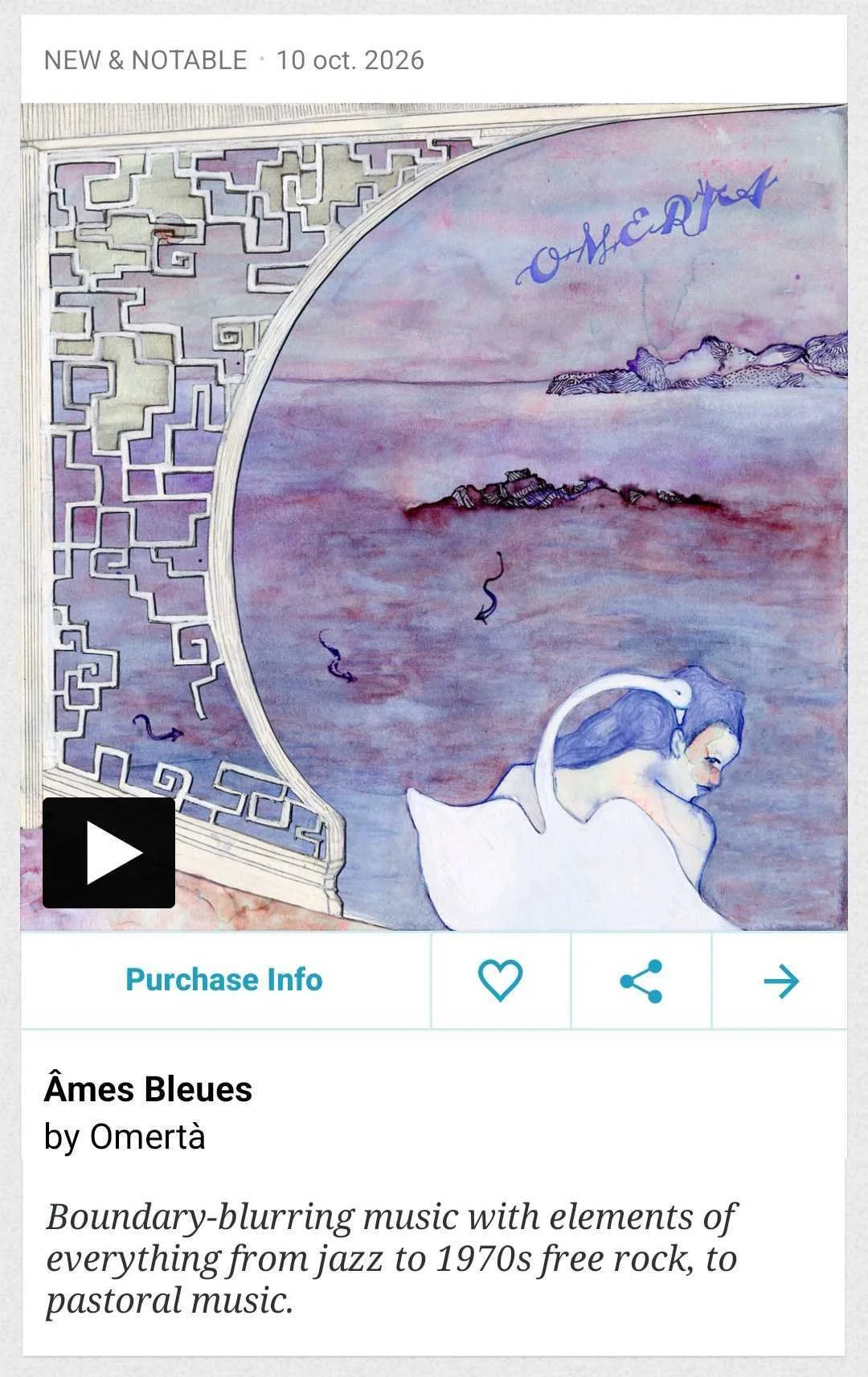
omertà | âmes bleues @ section 26 (fr)

Omertà, Âmes bleues (Standard in-Fi, Carton, ZamZam Records)

Auteur Renaud Sachet
Publié le 12 octobre 2026 Catégories chronique nouveauté ÉtiquettesAnnée : 2026, Label : Carton, Label : Standard In-Fi, Label : ZamZam Records, Lieu : France, Omertà

« Dormir dans les champs, entendre le vent effacer ton souvenir »

C’est en 2022 que Musique Journal, par la plume d’Etienne Menu, avait attiré mon attention sur ce super groupe lyonnais (encore un). Super au sens où il réunissait un aréopage de personnalités s’épanouissant chacun.es de leur côté dans la musique ou les arts. On rigole un peu avec cette notion de super groupe, parce que l’époque n’est plus à la bagarre d’ego, mais plutôt à la complémentarité, la transversalité, et tout cela fonctionne heureusement très bien à l’échelle du territoire et de ses souterrains. Avec, donc, pour ceux que je connais et ça suffirait déjà : Romain de Ferron, de Balladur, un des meilleurs trucs à voir en concert de ses dernières années, ou autre un autre Romain, Hervault qu’on a croisé dans Société Etrange. No offense, les autres, hein, comme on dit, de toute façon, « le tout est plus grand que la somme de ses parties ».

Après Collection Particulière (2022), donc, et un premier disque éponyme en 2017, le collectif, appelons ça comme ça, revient aux affaires avec Âmes Bleues qui s’inscrit dans la droite ligne du précédent : atmosphères planantes, aux rythmiques hypnotiques, qu’on situerait dans une sorte de new wave contemplative (flanger au diapason) derrière laquelle Maurice Deebank pourrait se tenir en embuscade (mais il n’est pas là),  coiffées par la voix obsédante de Florence Giroud. L’artiste se livre à travers des mots portés par les émotions de sa voix, sans que sa litanie ne livre clé en mains de sens trop précis. On ressent surtout des choses, mais sans que tout soit fléché, au contraire, plus on avance, plus on se perd (surtout quand le langage devient autre, italien je pense, mais j’ai des doutes), mais c’est ça qui est bien, sauf peut-être dans le désarmant et frontal Paranéa (sommet, clair). Même quand elle chante, même quand elle s’énerve, ou qu’on la surprend en plein petit hommage (face A, plage 3, parfait), son timbre continue de rassurer, malgré la gravité de ce qu’on croit comprendre (« le sacrifice et l’isolement », pas mal le résumé en deux mots de cette littérature).

Comme on est un peu retord et obsessionnel, on se dit que c’est un disque post Lithium dans sa façon d’imposer majoritairement ce parlé-chanté tant apprécié des pensionnaires de la maison de disques des années 1990. Les chansons non formatées imposent leur notion du temps (en moyenne plus de 5 minutes), toujours en douceur, un morceau instrumental pour s’installer, un autre pour se quitter, Omertà fait ça dans le respect, sans brusquerie instrumentale aucune. Tranquille intranquillité, le meilleur état possible.

Âmes bleues par Omertà est sorti chez Standard in-Fi, Carton, ZamZam Records

frantx | idutydu @ blow up magazine (it)

IMRONOISEDADAFOLK
Frantx
IDUTYDU · CD/LP/DL Carton Records · 11t-42:35

Arriviamo con qualche mese di ritardo a queste due recensioni di dischi carton records, etichetta francese che invece merita tutta l’attenzione possible. Quattro voci, tuba e synth giocattolo (Fanny Meteier), melodica e elettronica (Andrea Giordano), chitarra acustica ed elettrica (Pierre Pradier), batteria e elettronica (Marco Luparia, del quale abbiamo già scritto su BU#298): questo l’assetto per l’esordio dei Frantx, caleidoscopia internazionale avant-tutto che dichiara di muoversi da qualche parle tra Hello Kitty e Anthony Braxton. Al netto di qualche lungaggine forse e di qualche passaggio non sempre pienamente a fucco, il disco sorprende per feschezza e benvenuta follia: figlio ispirato e settimino di un quartetto coraggioso sino alla sfrontatezza nel mescolare davvero di ogni, tra gastriti imro, lucine pop Animal Collective, sgardi e sgorbi weird, libertà nella e dalle forma, caramelle noise-pop, ruggini industrial, bagliori avant, tecniche estese, amplificazioni eterodosse, folgorazioni glitch, estensioni elettroniche, fulmini jazz e chi più ne ha più ne metta, da Providence alla sede di un qualche conservatorio occupato da freaks 4.0. Su Bandcamp si definiscono une band glit-noise con sede a Parigi che crea musica in una dimensione iper-veloce in cui le individualità si sfociano, immerse in derive sonore post-internet. Suoni per ballerini dalle gambe strane, alla ricerca di nuovi modi di ascoltare e sognare, siamo molto curiosi di testarli dal vivo (è in preparazione un tour, speriamo capitino pure nel nostro derelitto paese): su disco sono molto, molto, molto promettenti. [7.9] Nazim Comunale

reviewSeb Brunfrantx, idutydu
séismes | seùlseùl @ monolithcocktail.com

The Digest for October 2026: New Music/Halloween Playlist/Archives

October 8, 2026

The Monthly Digest includes a clutch of accumulated new music reviews, this year’s Halloween Playlist selection, a piece from the Archives and jukebox selection of anniversary celebrating LPS.

Séismes ‘SeùlSeùl’
(Carton) 30th October 2026

Without upsetting anyone’s preferred pronouns, I’m assuming that its ok to state this is an all-female sextet working within – but very loosely – the free jazz and fourth world fields of experimentation and both magical and mysterious abstractions. And it shouldn’t be the case in 2026, but this is extremely rare.

Felt via healing balms of the near new age and exotic, and by passages of intensity, the Séismes (translates as “earthquakes”) lineup of Mélanie Loisel (on double bass), Tatiana Paris (guitar), Léa Ciechelski (saxophone, flute), Aline Bissey (also on flute), Yurie Hu (keyboard, viola) and Marine Flèche (drums) also all contribute vocals and electronic effects to an improvised recorded debut album that combines both European and Korean influences and cultural sources.

Encouraging the geographic, scenery and projections of dramatic introspection and bathos, the “alone” aspects of the SeùlSeùl album title describe both standing amongst the exotic foliage and moving in unison with the rhythms of nature: at peace and yet also animated and fidgety. The troupe’s scope of influences and improvised exploration draws (to these ears anyway) upon Jon Hassell, Roberto Musci, Nicole Mitchell, Laraaji, Alice Coltrane and Walter Smetek, but delves even further and broadly to conjure up some surprises along the way. In practice this means nature’s rustles, the air and breeze act as a backdrop to the group’s atonal wind and brass instrument huffs, chuffs, hinges, dreamy drifts and articulations; to the scratchy, textural, scrapes and chinks of the tin and metal percussion; and the flexed but also sensitive combination of scuttled stick rolling and more rhythmic drums. And then you have the electronic aspects – that’s various oscillations, generator like Fortean crackles and plastique resonance – and the voices, which can be either in a singing fashion or delivered through the duet of flutes and the saxophone – sometimes sounding very vocally cooed and at others like some odd cuckoos.

There’s much to pick out from this imaginative and stirring assemblage performance; the familiar recall of Max Andrejewski’s Hutte & Guests take on Robert Wyatt on the Nordic-sounded and deliciously blurry fresh look at the world ‘Glasses’, and the near Krautrock momentum built up on the plastic pipped and Metheny guitar harmonics tweeting, percussive shaking and intense climatic ‘Du Jaune’ (“yellow”). There’s a John Zorn dimension to the title-track, and a mix of Franco-Hawaii, the magically rural, and the Balkans on the vocoder-effected vocalised ‘Pasteque’ – the parting vocals sound very folksy, almost Celtic. And you could almost suggest a touch of Staraya Derevnya on the poetically abstract ‘Cheveux au Vent’ (“hair blowing in the wind”).    

All in all, an impressive debut of the ecological vibed, the organic fused with the electronic pulses and generators of modernity and dreamy lofty aspirations of untethered free sonic, atonal and rhythmical experimentation. Deerhoof meets Tortoise and Sam Rivers in a hinterland balanced somewhere on the astral panes between France and South Korea. In other words: this is for those who wish to immerse themselves in new soundscapes and visions.

electric rastrello | first of the list @ muzzart (fr)

Electric Rastrello « First of the list »

(EP. CARTON RECORDS/Burning Sound/Ur Suoni/Table Basse/Rotten / trash, 9 OCTOBRE 2026.

Will Dum
08/10/2026

Electric Rastrello continue d’explorer le mal qui jaillit de la bouche des politiciens italiens, mais plutôt ici en faveur du changement. L’optique change donc; le son, lui, creuse son inscription dans une veine électro (et autres) underground. Luciano Turella | drums et Mattia Benuzzi | electronics and vocals, dans le sillage d’un First of the List qui ouvre dans de sévères pulsions de drumming mâtinées d’électro sauvage, d’un chant volubile qui pourrait parfois évoquer (de loin) LCD Soundsystem, concoctent un registre audacieux. Hospital Ballroom, moins frontal mais tout aussi déviant, ondule spatialement. Ses phases aériennes font mouche, à l’instantané. Il hypnotise, ses sons envoûtent. La découverte est pour moi d’importance, dans l’esprit comme en termes de contenu.

Pour me conforter dans mes dires In Front of Your Heaven, saccadé, robotisé dans certaines parts de ses vocaux, indus, hip-hop tout ça mêlé et ouais Biggy!, marque la différence du duo. Sa non-déférence, aussi, vis à vis des normes. Des percées noisy s’immiscent, le rendu est entièrement hybride et surtout, addictif jusqu’au bout de la danse. On n’en décroche pas. The Coolest Summer of the Next 300 Years vient alors finir la série de quatre, au gré d’une trame vaguement drum’n’bass, jungle, percutante mais jonchée d’incrustes célestes. La toute fin se déploie en roue libre, ahurissante, au point de faire de ce First of the list l’un de immanquables de la « zik de lisière » de ce mois d’octobre.

upcoming gigs | concerts à venir

burning sound labs | la chaux de fonds (ch) | 15 october 2026
la gueule noire | saint etienne (fr) | 16 october 2026
café de la paix | arles (fr) | 17 october 2026
ojala este mi bici | barcelona (es) | 19 october 2026
plug in the gear | benicarlo (es) | 20 october 2026
galaxie xxiii | pau (fr) | 21 october 2026
tba | saint-jean de luz (fr) | 22 october 2026
tdf | tour de faure (fr) | 23 october 2026
les 9 salopards | marseille (fr) | 24 october 2026
cave 12 | geneva (ch) | 25 october 2026

bobo & behaja | aia haja? @ songlines (uk)

Introducing: Bobo & Behaja

14 May 2026

Lucia Gadau meets Maxime Bobo, the free-jazz-loving French saxophonist who, with Malagasy guitarist Behaja, is carrying Madagascar’s ceremonial tsapiky music to the world

An electric guitar and saxophone simultaneously kick into action on ‘Parepare’, the first track on Bobo & Behaja’s debut album Aia Haja?. The bass and drums jump as the song erupts into a non-stop tsapiky groove with vocals that playfully skip along.

Tsapiky is upbeat and rhythmic ceremonial music, played during weddings, funerals and local festivals in south-western Madagascar. Originating in the 70s, it takes its cue from indigenous Malagasy music, although Bobo & Behaja’s Maxime Bobo is quick to point out that it’s a living tradition, propelled by amped-up guitars and relentless percussion: “It’s played in the traditional context,” he says, “but it’s modern music because it was born with the electric guitar, bass and drums.”

Bobo now adds sax to the genre’s arsenal. Curiously, it was through free-jazz greats like Ornette Coleman that Bobo first found a route into African music. He explains that Coleman played “lots of very bright, joyous melodies, with major, diatonic scales”, saying that he “fell in love with lots of modern African music” because it had the same “repetitive riffs and major scales” and also allowed for lots of improvisation. In particular, he became fond of tsapiky, wanting to learn how to pick apart its tight rhythmic structure. “Subconsciously,” he says, “I wanted to be able to play it even ten years ago.” Older Malagasy musicians from the 90s like guitarist Damily and his brother Rakapo became artists that he looked up to. “I was hoping to meet them and be able to play with them one day,” he says.

In 2018, Bobo travelled to Madagascar with his then-band Electric Vocuhila to meet and rehearse with Rakapo, who took him to a mandriampototsy. This is a celebration, which could be a wedding or funeral, and can last from three to five days, and typically features tsapiky. It was his first encounter with the Malagasy guitarist Behaja. “We rehearsed for two weeks in Madagascar just so we could hear [Behaja’s] songs while trying to adapt them to what we were doing,” he says. The fruits of that trip can be heard on Kiteky, a 2022 album by Electric Vocuhila. The album featured Behaja and other Malagasy musicians and gained acclaim in Madagascar.

After Kiteky, Bobo wanted to continue working with Malagasy musicians, and he formed Bobo & Behaja. “Most tsapiky bands get their name from the guitar player,” says Bobo, but on this album it’s himself and Behaja who get equal billing. This is because, unlike most tsapiky bands, Bobo & Behaja are led by sax too. On the extended improvisations that are such a big part of the music, it is the two of them who alternately lead the charge. Rounding out the group are Bobo’s fellow Frenchman, bassist François Rosenfeld, and from Madagascar: Gérard Rakotoniaina on drums, and either Malala, Ekaly or Pelahita on vocals.

“It’s very important for me to collaborate with Malagasy musicians,” says Bobo, who doesn’t want to simply learn from tsapiky musicians and then teach the style back in France. In 2025, Sublime Frequencies released Tsapiky! Modern Music From Southwest Madagascar, a set of new tsapiky tracks recorded live by Bobo which featured Behaja, Rebona and other contemporaries. This was an extension of his work with Fifangaroa, a non-profit organisation supporting tsapiky musicians which has been publishing collections of recordings from Madagascar on Bandcamp. “As a musician, I feel I also have to help them be known,” says Bobo. “I’m trying to get tsapiky out of Madagascar.”

+ Aia Haja? is out now. ‘Rafoza Manday Tandra’ is on this issue’s Top of the World compilation, track 13

bobo & behaja | aia haja? @ radio student fm 89.3 (si)

Bobo & Behaja: Aia Haja?

Audio file

Predvajaj (6:09)

Vir: Naslovnica izdaje / Bobo & Behaja

Celostnost glasbenih potez, ki brbotajo od nalezljivosti

Carton Records, 2026


Pestra ritmika in navidezno nenadzorovani melodični prijemi, ki v sebi nosijo dobršno mero spretnosti izvedbe, so nepogrešljive sestavine glasbe, ki na poslušalsko uho v nemalo primerih delujejo z unikatnim izkupičkom ob boku. »Oh, ta glasba me pa kar spravi v nek trans!« bi brez težav slišali tudi v kontekstu albuma kvinteta Bobo & Behaja z naslovom Aia Haja?, ki ga obravnavamo v tokratni Tolpi bumov. Toda pri obravnavi glasbe francosko-malgaške zasedbe je smotrneje uporabiti kakšne bolj podkrepljene pristope. Subjektivno dojemanje je resnična stvar, in širši množici, ki ni nujno ciljna, morda raje le številčnejša, omenjeni obljubljeni trans pridoda dovolj – dovolj, da se bo nekdo kljub nepoznavanju konteksta glasbe ali pa osnovnih vprašanj, ki jih ta odpira, vendarle odločil za nakup vstopnice za obisk koncerta. 

Glasba zasedbe Bobo & Behaja se napaja v tradiciji glasbene zvrsti tsapiky, izrazito plesnega žanra z jugozahodnega dela Madagaskarja, ki se nanaša na zvočnost obredov bal-poussière, v osnovi tradicionalno družbenih in obrednih dogodkov. Gre za večdnevna praznovanja na prostem, ki pogosto potekajo ob pomembnih življenjskih prelomnicah, kot so poroke in pogrebi, pa tudi razni lokalni festivali. Že zaradi korenin glasbe zasedbe bi na prvo žogo zlahka zapadli v diskurz konstrukcije avtentičnosti, fascinacije z Drugim ali pojava omenjenega transa in pretakanja takšnih in drugačnih notranjih občutij. Seveda ne smemo zanemariti individualne izkušnje poslušalke – ki si jo v kontekstu Boba & Behaje nedvomno deli kar dobršna mera slušateljev – toda njihova glasba v maniri, ki je stabilna, v prvi vrsti vredna obravnave in podkrepljena z ničkoliko vidiki, še vedno uspeva oziroma živi.

Francoski saksofonist Bobo Maxime, sicer član zasedbe Electric Vocuhila, ki jo večkrat zasledimo pod nalepko tropikalni jazz, je v preteklosti velikokrat obiskal Madagaskar, kjer se je spoznal z žanrom tsapiky. Skozi raziskovanje se je povezal z lokalno zasedbo Behaja, poimenovano po njenem kitaristu, in danes lahko z albumom Aia Haja? opazujemo, na kakšne načine je saksofonist Maxime skušal zaorati ledino na področju srečevanja tsapikyja s tradicijo rocka in jazza. To mu zelo dobro uspeva prav zaradi prisotnosti njegovega inštrumenta, ki na albumu neredko prevzame vlogo gonilca zvočnega toka. Kljub temu glasba izžareva kolektivnost, kakršnekoli težnje po performativni glasbeni praksi, ki bi jo narekoval izključno Maxime in imel zasedbo Bahaja samo malo za zraven, pa niso navzoče. S sodelovanjem v ustreznem pomenu te besede se tudi s poslušanjem zazna hommage zgodovinskemu kontekstu žanra tsapiky, kar je najverjetneje v prvi vrsti tudi smoter tega projekta. 

V posameznih skladbah ne zasledimo kompleksnih modulacij v druge tonalitetne nastavke. Slušna izkušnja vztraja v določeni natempirani in vedri špuri, toda to še zdaleč ne pomeni, da glasba zasedbe Bobo & Behaja ni kakovostno izvedena in zasnovana – ravno nasprotno: neposrednost utrdi njihov izraz, ki, ko ga podrobneje analiziramo, deluje sila natančno. Izstopajo bogati ritmični segmenti, ki bi jih s poglobitvijo vanje lahko razstavili na manjše odseke. Kitarist Behaja note ubira kot za stavo, se pri tem navidezno spontano in brez napora ujame s preostalimi člani zasedbe in njihovimi inštrumenti ter gradi skoraj neprekinjen zvočni tok kompozicij, ki se spajajo v celoto. 

Gibanje je nekaj, kar nam brž pride na misel in se nenazadnje neposredno manifestira tudi v naše dejansko fizično stanje, kar se bo, si upamo trditi, izrazilo tudi na koncertu, ki ga bo zasedba izvedla na letošnji, 42. ediciji festivala Druga godba 29. maja v Katedrali Kina Šiška. Gibanje zaznamuje potek glasbenih pasaž, s katerimi koketira vokalistka Ekaly. Z inštrumentalno sekcijo vzpostavi izrazito prožen dialog, podaja odgovore na zaigrane fraze in utrjuje že predstavljene glasbene motive, najbolj nazorno v skladbi Kabosy, katere izmenjevalni odsek glasu in kitare bi pravzaprav lahko trajal v nedogled. Tudi ko Ekaly ne slišimo, denimo v skladbi Rodobey, odmev njenega glasu na nek način ostaja prisoten. 

Na prvi posluh Bobo & Behaja vseskozi ostajajo v istih kolesnicah, toda te kolesnice so tako dobro uvožene, da se med poslušanjem začnemo preizpraševati o zmožnosti glasbe, da popolnoma zaobjame svojo zasnovo in v njej tudi celostno deluje. Analiza posameznih skladb z albuma tako niti ne bi bila prikladna. Smiselneje se je osredotočiti na celostnost glasbenih potez, ki brbotajo od nalezljivosti in album Aia Haja? opolnomočijo z neomajno atmosferično napetostjo.

hassan k. | gharbzadeh @ the quietus (uk)


Hassan K

Gharbzadeh
Carton / Cheap Satanism / Extra Normal / Gandula / Industrie Musicale / Istotne Nagr. / October Tone

Franco-Iranian artist Hassan K. had Iran very much on his mind during the creation of Gharbzadeh, which is a word meaning ‘Westernization’ coined by Iranian critic Jalal Al-e Ahmad. Its clash of styles therefore feels deliberate and pointed, but it’s also thrillingly energetic. As with 2021’s Isteghana, this isn’t a melting pot, with disparate ingredients fused into a homogeneous whole. Instead, it is powered by fissures, friction and violent collisions: twanging, surfy setar meets bludgeoning metal riffs; dramatic virtual strings, midi flute and spirited keyboard lines all vie for attention throughout the rattling opening run of ‘Khwajeh Ye Hikmat’, ‘Zahir’ and ‘Karek Ve Taryak’. ‘Baba Karam’ adds filthy, fizzing synth bass and organ stabs that are like punches to the face, and the gnarly, proggy ‘Ma Bad Al Tabi At’ adds accordion from Charles Kieny of progressive jazz metal band Ckraft. ‘Asra’ is four minutes of brutal techno, thundering drums and clattery percussion, doom metal guitar and a preposterously dramatic finale that leaves you short of breath. Following that, the moody but relatively tranquil ‘Kangah’ provides momentary respite. Masto, formerly saxophonist with 80s squat-punk heroes Bérurier Noir, shows up on ‘Bazgash Bah Soal’, which builds patiently into a knotty math / jazz piece. Gharbzadeh is a wildly provocative ride.