
Mardi 17 novembre à 20h sur @campus94fm dans le Unikradioshow nous recevons @generique_mardi . Iels viennent nous présenter leur nouveau album "Diane" en coproduction avec Carpacio Cathédrale, Carton Records & La République des Granges. Au programme, écoutes commentées de morceaux choisis et interview.
Générique Mardi est un duo queer formé en 2022 à Toulouse, né de la rencontre entre Juliette Pym et Bonella Holloway. Leurs morceaux sont composés, écrits et chantés ensemble, invitant le public à découvrir un univers intime et sensible. Leur direction musicale invoque un esprit pop LO-FI aux accents No-Wave et de poésie sonore. Iels portent aussi une attention très particulière autour des domaines artistiques qui entourent leur musique faisant écho à leurs travail dans l'art contemporain. Leurs mélodies simples et répétitives parlent du quotidien, des dépendances, d'amours perdus, de souvenirs, d'amitié, d'anxiété, interprétés d'une manière brute et sophistiquée, où la pop est froide et la fête douce-amère.
Le Dégel #49 w/ Borguefül
Pour la sortie de son second album, Borguefül vient nous narrer des bouts de sa vie en musique, entre les rencontres qui font tout tournoyer, les influences qui s'entendent dans les coups d'archet, et pourquoi avoir choisi de jouer de la contrebasse alors qu'on n'a plus le droit de la transporter en train.
Tracklist :
Borguefül - Du sable malin
Borguefül - Les Lapins
Borguefül - ROcher multiple
François Rabbath - Impalas
The Ex & Tom Cora - Hidegen Fujnak A Szelek
L'ocelle Mare - Porte d'octobre
Yma Sumac - Cuncho
Meredith Monk - Hips Dance
Fontaine & Areski - Vous et nous
Piss - Time loop at hot slit
Clipping. - Wake up
Instagram :
www.instagram.com/melanieborgueful/?hl=en
________
Station Station est une webradio associative qui émet 24/24 et 7/7j, basée à La Station - Gare des Mines. Pour écouter le direct : www.stationstation.fr nous suivre : www.instagram.com/stationstation_radio/ - @stationstation - www.mixcloud.com/Station_Station_radio/stream/
Introducing: Bobo & Behaja
14 May 2026
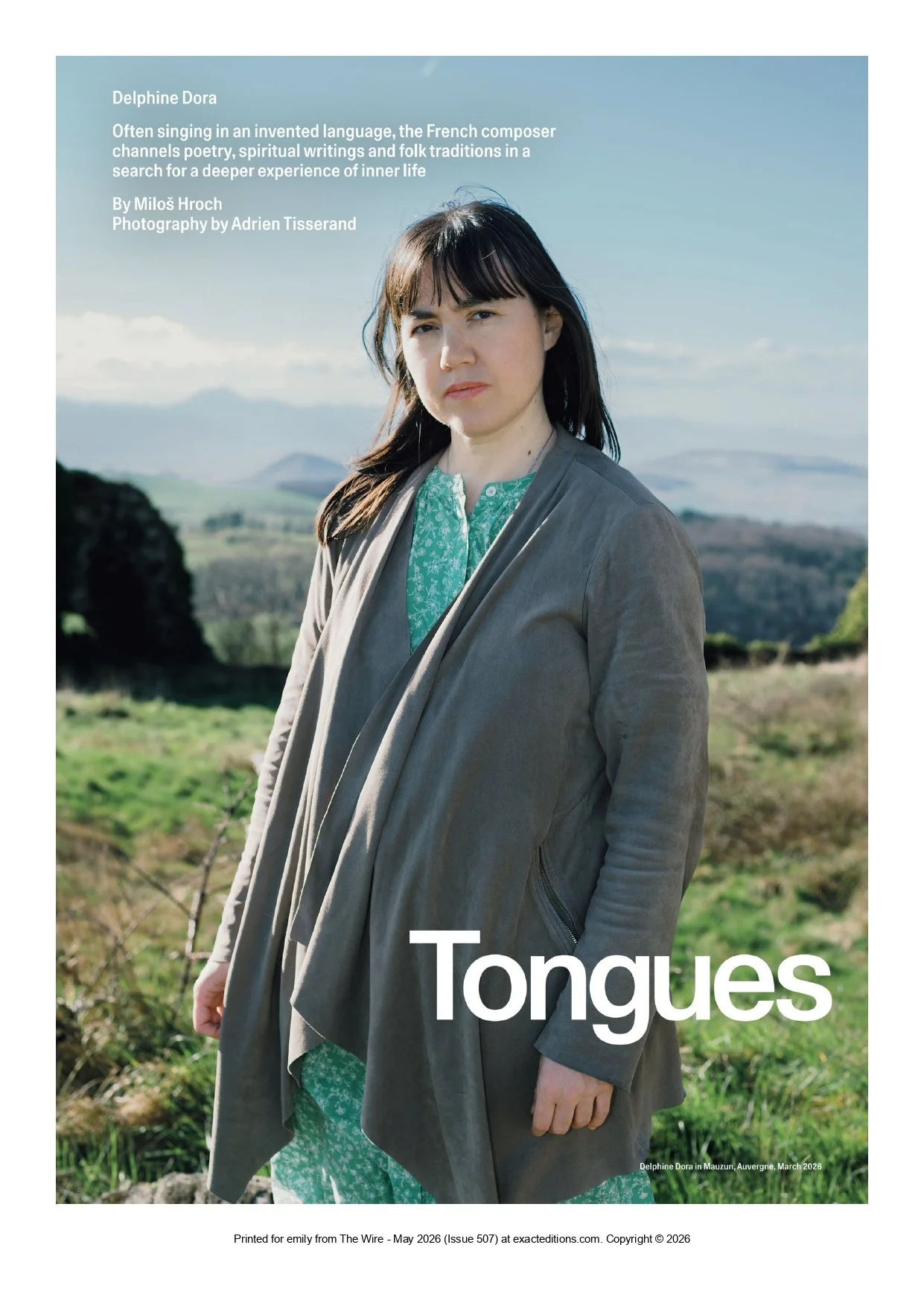
Lucia Gadau meets Maxime Bobo, the free-jazz-loving French saxophonist who, with Malagasy guitarist Behaja, is carrying Madagascar’s ceremonial tsapiky music to the world
An electric guitar and saxophone simultaneously kick into action on ‘Parepare’, the first track on Bobo & Behaja’s debut album Aia Haja?. The bass and drums jump as the song erupts into a non-stop tsapiky groove with vocals that playfully skip along.
Tsapiky is upbeat and rhythmic ceremonial music, played during weddings, funerals and local festivals in south-western Madagascar. Originating in the 70s, it takes its cue from indigenous Malagasy music, although Bobo & Behaja’s Maxime Bobo is quick to point out that it’s a living tradition, propelled by amped-up guitars and relentless percussion: “It’s played in the traditional context,” he says, “but it’s modern music because it was born with the electric guitar, bass and drums.”
Bobo now adds sax to the genre’s arsenal. Curiously, it was through free-jazz greats like Ornette Coleman that Bobo first found a route into African music. He explains that Coleman played “lots of very bright, joyous melodies, with major, diatonic scales”, saying that he “fell in love with lots of modern African music” because it had the same “repetitive riffs and major scales” and also allowed for lots of improvisation. In particular, he became fond of tsapiky, wanting to learn how to pick apart its tight rhythmic structure. “Subconsciously,” he says, “I wanted to be able to play it even ten years ago.” Older Malagasy musicians from the 90s like guitarist Damily and his brother Rakapo became artists that he looked up to. “I was hoping to meet them and be able to play with them one day,” he says.
In 2018, Bobo travelled to Madagascar with his then-band Electric Vocuhila to meet and rehearse with Rakapo, who took him to a mandriampototsy. This is a celebration, which could be a wedding or funeral, and can last from three to five days, and typically features tsapiky. It was his first encounter with the Malagasy guitarist Behaja. “We rehearsed for two weeks in Madagascar just so we could hear [Behaja’s] songs while trying to adapt them to what we were doing,” he says. The fruits of that trip can be heard on Kiteky, a 2022 album by Electric Vocuhila. The album featured Behaja and other Malagasy musicians and gained acclaim in Madagascar.
After Kiteky, Bobo wanted to continue working with Malagasy musicians, and he formed Bobo & Behaja. “Most tsapiky bands get their name from the guitar player,” says Bobo, but on this album it’s himself and Behaja who get equal billing. This is because, unlike most tsapiky bands, Bobo & Behaja are led by sax too. On the extended improvisations that are such a big part of the music, it is the two of them who alternately lead the charge. Rounding out the group are Bobo’s fellow Frenchman, bassist François Rosenfeld, and from Madagascar: Gérard Rakotoniaina on drums, and either Malala, Ekaly or Pelahita on vocals.
“It’s very important for me to collaborate with Malagasy musicians,” says Bobo, who doesn’t want to simply learn from tsapiky musicians and then teach the style back in France. In 2025, Sublime Frequencies released Tsapiky! Modern Music From Southwest Madagascar, a set of new tsapiky tracks recorded live by Bobo which featured Behaja, Rebona and other contemporaries. This was an extension of his work with Fifangaroa, a non-profit organisation supporting tsapiky musicians which has been publishing collections of recordings from Madagascar on Bandcamp. “As a musician, I feel I also have to help them be known,” says Bobo. “I’m trying to get tsapiky out of Madagascar.”
+ Aia Haja? is out now. ‘Rafoza Manday Tandra’ is on this issue’s Top of the World compilation, track 13
BPM – Bonnes Pulsations du Monde
Le retour de Masego, une journée aux Suds, à Arles, et le feu intérieur de Groundation
Publié le : 24/07/2026 - 17:10
Cette semaine dans votre selecta : un artiste afro-américain d'ascendance jamaïcaine qui mêle avec une élégance folle R&B, jazz et rap et fait de la vulnérabilité une force ; un festival de « musiques d'un monde en mouvement » où tsapiky malgache, chants kurdes et MPB se rencontrent. Et « l'histoire d'un live » du groupe de reggae-roots californien Groundation.
Avec la complicité, au festival Les Suds, à Arles…
De la chanteuse brésilienne Mari Froes, dont le premier album, Esquina do Sol, sort le 31 juillet ;
Du chanteur et multi-instrumentiste kurde Ali Doğan Gönültaş ;
De deux des cinq membres du groupe Bobo et Behaja : le saxophoniste français Maxime Bobo et le guitariste malgache Behaja.
Se développer sans les réseaux sociaux, avec Hassan K
Hassan K, il tourne en France et à l'international... et pourtant, il est inexistant sur Facebook, Instagram ou encore TikTok. Vous vous doutez bien qu'avec cette information, quand je l'ai rencontré, je l'ai immédiatement eu en tête pour un épisode de Parcours d'Indés!
On évoquait il y a deux semaines le développement sur les réseaux sociaux avec Bleu Berlin, aujourd'hui, on explore ce qu'on appelle encore les "réseaux alternatifs" - le DIY, le digital hors réseaux sociaux, le "terrain" - des réseaux humains, de la "vraie vie", qui existent depuis toujours et qui sont pourtant encore vus comme marginaux par la plupart des gens.
#SessionLive Leïla Martial + Bobo & Behaja
Où l'on convoque Jean-Sébastien Bach, les polyphonies pygmées et le tsapiky malgache !
Notre première invitée est la musicienne Leïla Martial pour la sortie de Jubilä 432, oui Jubilä déesse de la jubilation 🎈🔥
JUBILÄ 432 est le nom du nouvel album de Leïla Martial, véritable point d’orgue et quintessence de toutes ses explorations vocales. Elle a toujours su qu'elle l’enregistrerait, cependant il lui fallu des années d’expériences, de rencontres et de virées en sac à dos pour se sentir prête. Scoop : c'est par l'écriture de ce disque que toute l'aventure en solo a commencé il y a 4 ans. Leïla Martial a été récompensée en 2026 aux Victoires du Jazz comme étant la meilleure artiste vocale 2026. Prix amplement mérité !
Leïla Martial à RFI. © Laurence Aloir/RFI
Titres interprétés au grand studio :
- Malia Live RFI
- La Rencontre, extrait de l'album
- À l'enfant que je n'aurai pas Live RFI.
Line Up : Leïla Martial (voix, machine, percus)
► Album Jubilä 432 (Full Rhizome 2026).
Site - Instagram - Bandcamp - YouTube.
Puis nous recevons Bobo & Behaja dans la #SessionLive pour la sortie de Aia Haja ?
Ce quintet franco-malgache explore les nouvelles sonorités et rythmiques effrénées du tsapiky, jeune musique de transe des bals-poussière du sud-ouest de Madagascar. Prolongement de la collaboration entre Electric Vocuhila et les musicien·ne·s du groupe du guitariste Behaja, cette formation réalise une combinaison inédite avec le saxophone, en fusionnant tsapiky, (free) jazz et rock.
Bobo & Behaja à RFI et Bobo & Behaja. © Laurence Aloir / Bobo & Behaja
Originaire de Sakaraha, au sud-ouest de Madagascar, Behaja est l'un des musiciens les plus influents du tsapiky contemporain. profondément ancré dans la tradition du tsapiky mandriampototsy (bal-poussière), il est reconnu pour sa maîtrise des nouvelles techniques guitaristiques, rythmiques et structures apparues ces 10/15 dernières années dans la région de Tuléar.
Passionné par le tsapiky malgache depuis une dizaine d'années, le saxophoniste Maxime Bobo (Electric Vocuhila, Mitsaitsaiky) se rend régulièrement à Madagascar pour jouer avec différents groupes de tsapiky moderne (Behaja, Rebona, Mahapoteke) et mener un travail de recherche et de collectage afin de comprendre et de documenter l'évolution actuelle de cette musique (cf la compilation tsapiky! Modern Music From Southwest Madagascar parue en avril 2025 sur le label Sublime Frequencies).
Titres interprétés au grand studio :
- Anotsy Live RFI
- Tantely Male Zay, extrait de l'album
- Lahy Tsy Niha Live RFI.
Line Up : Pelahita Malala | voice, Maxime Bobo | saxophone, Behaja | guitar, François Rosenfeld | basse, Gérard Rakotoniaina | drums.
► Album Aia Haja ? (Carton Rd 2026)
Instagram - Bandcamp - Clip Parepare.
Son : Mathias Taylor, Benoît Letirant, Jérémie Besset.
Réalisation : Donatien Cahu.
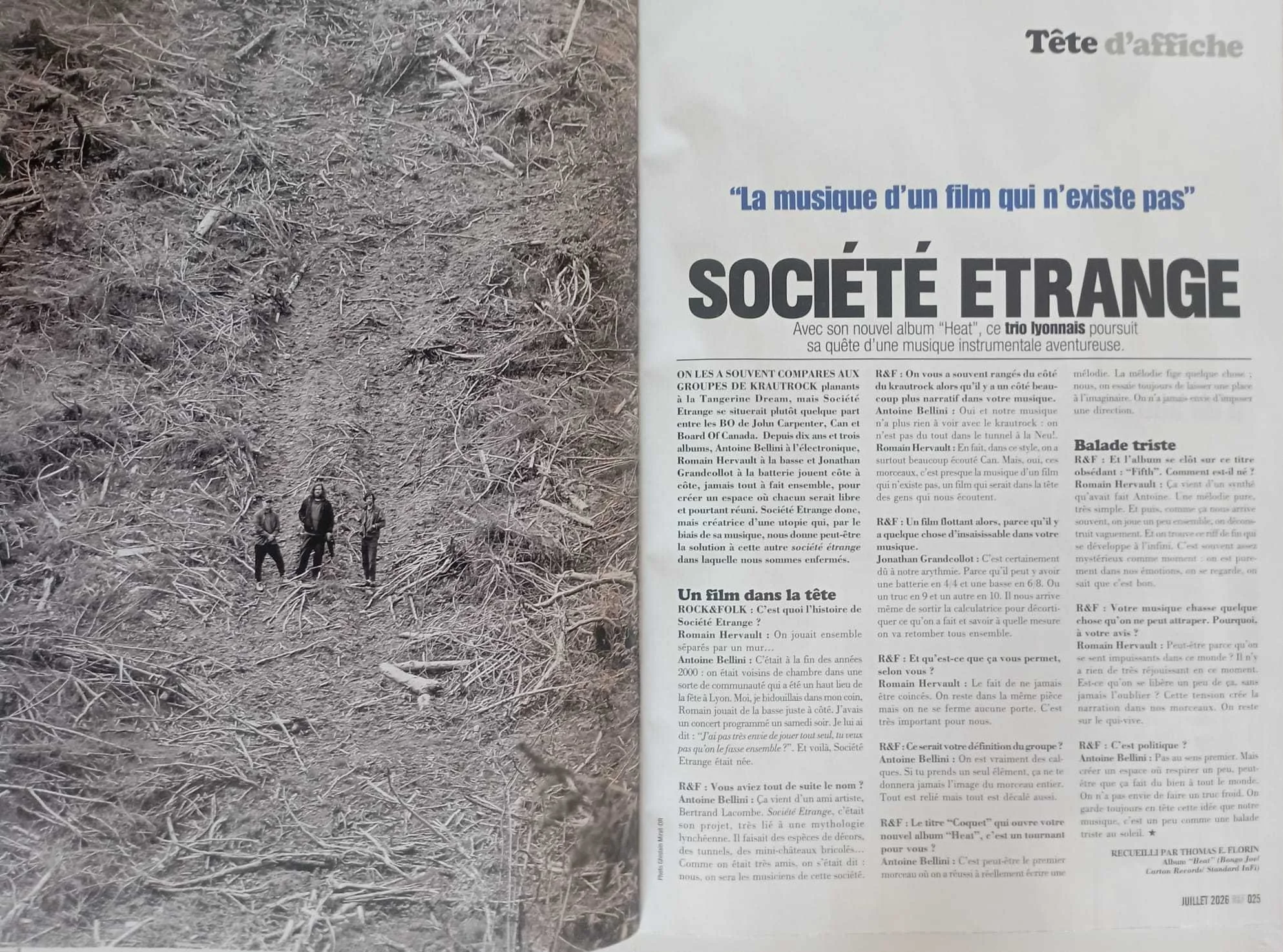
SOCIÉTÉ ÉTRANGE
Avec son nouvel album “Heat”, ce trio lyonnais poursuit sa quête d’une musique instrumentale aventureuse.
ON LES A SOUVENT COMPARÉS AUX GROUPES DE KRAUTROCK planants à la Tangerine Dream, mais Société Étrange se situerait plutôt quelque part entre les BO de John Carpenter, Can et Boards of Canada. Depuis dix ans et trois albums, Antoine Bellini à l’électronique, Romain Hervault à la basse et Jonathan Grandcollot à la batterie jouent côte à côte, jamais tout à fait ensemble, pour créer un espace où chacun serait libre et pourtant réuni. Société Étrange donc, mais créatrice d’une utopie qui, par le biais de sa musique, nous donne peut-être la solution à cette autre société étrange dans laquelle nous sommes enfermés.
[…]
Recueilli par Thomas E. Florin
Album “Heat” (Bongo Joe/Carton Records/Standard In-Fi)
Juillet 2026 #025
Mélanie Loisel et Rachel Langlais, deux artistes en quête d’exploration sonore à Rezé
Les deux artistes, Mélanie Loisel et Rachel Langlais, seront de passage, à la Soufflerie, de Rezé, ce mercredi 5 février. Un co-plateau avec deux compositrices portant des projets hors des sentiers battus.
Ce mercredi 5 février, la Soufflerie de Rezé vibrera au rythme de l’expérimentation musicale avec la contrebassiste Mélanie Loisel et Rachel Langlais. Deux artistes aux parcours singuliers, unies par une même quête de sonorités inédites et une approche où se mêlent improvisation, textures et émotions.
Avec Borguefül, Mélanie Loisel façonne une musique où la nature et l’enfance ne sont jamais loin.
“J’ai grandi en Haute-Loire, passé du temps dehors. Cela m’habite...”
[Article réservé aux abonné·es]
In this interview on the occasion of Tangent Mek's debut album, the trio recount how improvisation guided composition and how important sound was to their overall vision. But they also mention conversations, travels, and memories – it's a radical ritual with a gentle induction.
Tell me about your instrument and/or tools, please. What made you seek it out, what makes it “your” instrument, and what are some of the most important aspects of playing it?
As a trio, we tend to think of our “instrument” as the collective sound we create together — something that has evolved and transformed over years of collaboration.
It is not only about the individual instruments we play, but about a shared way of listening, interacting and relating to each other’s sound. Through this process, the three voices gradually merge into one, forming a sonic identity that feels deeply personal to us.
This is what makes it “an instrument” in its own right: a unified sound without hierarchy, where three distinct identities coexist and blend. It has been moulded over time through playing, traveling, experimenting, laughing, and simply growing older together.
As for the essential aspects of playing it, we would highlight space, harmonics, acoustics, friction, and the constant attention to balance and presence within the group.
Derek Bailey defined improvising as the search for material which is endlessly transformable. What kind of materials have turned out to be particularly transformable and stimulating for you?
We believe that this idea of perpetual transformation is a fundamental aspect of the living world, not something that belongs only to music. When you watch a river flowing, for example, it becomes clear that the current is, in many ways, always similar, yet never the same.
If we were to point to a specific material in relation to our playing, we would mention our long-term exploration of harmonics — a material we are particularly drawn to and continue to develop across several pieces. Harmonics quickly became a vivid source of inspiration: a crystalline, almost celestial sound, floating in the air, with something nearly magical in the way it comes into being.
The viola da gamba offers a particularly rich harmonic spectrum, while the flutes and violin each bring their own distinct qualities and possibilities.
After spending countless hours working on these sounds—searching for them, coaxing them into resonance—it became clear that the further we go in this sonic exploration, the more the field expands and opens up, with new combinations constantly emerging.
Everything is in continuous transformation: under the fingers, but also in response to the space in which this sound material unfolds. Additionally, the weather conditions strongly influence how the sound is transmitted: it is a fragile, unstable material, one that continually brings us back to the acoustic space and the act of listening itself.
Do you feel as though there are at least elements of composition and improvisation which are entirely unique to each? When you're improvising, does it actually feel like you're inventing something on the spot – or are you inventively re-arranging patterns from preparations, practise or previous performances?
In our case, composition and improvisation are closely linked.
After many years of improvising together, we reached a point where we felt the need to move toward composition. In a sense, these compositions were only possible because of the long period of shared improvisation that preceded them. The compositional process itself often involved revisiting and reshaping patterns that had emerged through improvisation.
This is, of course, a particular way of composing collectively, but the music on our recent album could only have come into being through this compositional process. As musicians who both improvise and compose, it is therefore difficult to draw a clear line between the two; however, it is evident that this approach has introduced a new dimension to our work.
What balance is there between forgetting and remembering in your work?
Both play a crucial role in our practice.
Improvisation requires a certain ability to let go, to forget patterns, expectations and habits in order to remain open and present. At the same time, memory is always at work: it informs our listening, our choices, and the subtle re-emergence of materials shaped over time.
It is precisely in the tension between these two states that something new can arise.
Taking your recent projects, releases, and performances as examples, what, would you say, are the key ideas behind your approach to improvisation?
On our recent release, Immutable Traveler, our first album, we approached improvisation as a tool for composition.
We began by improvising without any predefined material or concept, allowing our conversations, travels, memories, and even the light and vastness of the room to flow into the music. From there, we improvised, recorded, listened back and selected the fragments that resonated most with us.
This material then became the basis for further development: we shaped, transformed, distorted, and re-recorded it, continuously modulating and refining it until a final form gradually emerged.
What are some of your favourite collaborators and how do they enrich your improvisations?
We would like to approach this question slightly differently and instead speak about what we hope to develop in the next phase of our work. For us, one of the most important collaborators moving forward is the sound engineer.
Following our recording experience with Benjamin Maumus on Immutable Traveler, we became more aware that our music contains a wide range of subtle details and sonic qualities that can only fully emerge and be heard through careful and refined amplification. This realization opened up a new perspective on how our sound can be shaped and perceived.
As a next step, we would like to build a close collaboration with a sound engineer and further explore this idea of nuanced amplification. Ideally, we would also tour together, allowing us to maintain a consistent and distinctive sound across different venues.
In a live situation, decisions between creatives often work without words. From your experience and current projects, what does this process feel like and how does it work?
We recently had the opportunity to play several concerts in a row while presenting our new album, and this experience revealed something essential about our way of working. Over the course of these performances, the pieces began to transform in ways that are difficult to fully articulate.
It is a process that unfolds through repetition, listening and shared presence. Without needing to speak, we gradually adjust to one another, allowing subtle shifts to emerge from within the music itself. In this sense, decisions are not consciously negotiated, but rather felt and embodied, arising from the collective experience of playing together.
Stewart Copeland said: “Listening is where the cool stuff comes from. And that listening thing, magically, turns all of your chops into gold.” What do you listen for?
Anna: We listen closely to the sound of the space itself: how it responds, resonates, and shapes what we do. We listen to how the audience is listening to us, and to how the music ultimately finds its final form in this shared moment of listening and sounding.
Anouck: For me listening seems to be the raw material of any sonic practice. It is about placing oneself in a listening context in order to finely perceive how things take shape, emerge, and come into being in real time. Listening is a thread that undeniably connects us, continuously, to the living world.
Marina: I experience listening as a space of freedom and possibility, an open field where anything can happen at any moment. I listen for the sound that might trigger a clear shift, for a harmonic that suggests a new direction, for the turning points: an overflowing silence or a sudden gesture that redirects the course of the music.
Listening becomes a way of navigating these transformations in real time, of recognizing when a situation calls for continuity, rupture, or redirection within the unfolding form.
As listeners, do you also have a preference for improvised music? If so, what is it about this music that you appreciate as part of the audience?
Yes, we attend as many concerts as possible. When listening to improvised music, what we particularly appreciate is the ability to perceive how musicians listen to one another—their quality of listening as expressed through the way they play, interact, and respond to what is unfolding in the moment.
The personal musical languages that emerge through long-term collaborations, the plasticity of sound: the sense of constant transformation and the opening of new possibilities. The different ways and strategies musicians use to direct the energy of a performance over time and to guide a set.
In a way, we improvise all the time. In which way is your creative work feeding back and possibly supporting other areas of your life?
The choice to work as musicians already affects our daily lives considerably, as the structure of the profession differs from that of a more conventional job. It brings with it both a sense of freedom and responsibility.
We are regularly faced with unexpected situations and have the opportunity to meet and interact with many different people, which is a very valuable experience in today's society.
interview with tangent mek, listen now
Un quintet franco-malgache, au carrefour des couleurs orientales et occidentales, c’est Bobo et Behaja. Un voyage où les surprises s’invitent sans se faire attendre… Des sonorités délirantes, aux rythmes trépidants, la musique nous emporte dans un tourbillon mélodieux, un mouvement indomptable.
Hopping over from the ridges of Nantes, Arnaud Aubry and Thomas Durand began their adventure as Elastic Systems in 2022, diving deep into human/machine synergy by means of wiggly electronic playtime.
Electronic drums and MIDI wares play interchangeably complementary roles and generate disparate forms that range from jaunty krautrock to sinewy body music to the open-ended chiptune of yesterday’s tomorrow. At times highly technical and angular, Elastic System’s improvisations can just as soon melt into free-floating waveforms that push listeners – and their dance moves – to engage in a perpetually shifting sonic worldbuilding, bringing it all together in a choose-your-own-adventure cascade of relentless euphoria.
When did Elastic Systems start? 2022?
Elastic Systems started in the summer of 2022, a moment in our lives when we had free time and wanted to try a new band based on the use of an electronic drum set. We spent several weeks trying dumb and funny jokes that later became songs.
I know only one three-track demo from you. Is this your only release?
The demo is the only release available for now. They were actually just recordings of rehearsals that we wanted to share to find our first gigs.
You are a duo. Can you introduce yourselves to me? Who are you? How old are you? How did both of you meet? What’s your musical background? Did you play in other bands before? Did you have any formal musical training? Did you study music?
We are Thomas Durand and Arnaud Aubry, respectively 30 and 31 years old. We didn’t grow up in arty families and explored music ourselves during our teenage years. We met at this point, going to experimental and punk gigs in Nantes. We were 17 and curious for new experiences in music and life. Thomas is a completely self-taught musician and has produced singular music under many aliases, such as the ongoing project Tutoriel. Arnaud started by taking drum lessons, and then later by doing a lot of improvisation by himself in the attic of his family’s house. He has later been part of several formations as a drummer, where improvisation always played a big part. Elastic Systems isn’t our first band together, as we played together in a punk band called Virage and a pop band called Shy Accident.
…
full interview here
chronicles of womex 2025
As has long been the case, the Mundofonías team attended the annual meeting of WOMEX, one of the largest events related to root musics on the planet that is held each year in a different city. In 2025 it took place in Tampere, Finland, and from there we bring impressions of some memorable concerts which we recall and which make us travel through Mali, Tanzania, Madagascar, Serbia, Taiwan and Mauritania among other destinations. We also share the conversations we had with Maxime Bobo, co-promoter of the Franco-Malagasy project Bobo & Behaja, and with the Taiwanese musicians of 3Peoplemusic. We listen to the winner of the Artist Award, the Mauritanian Noura Mint Seymali, and we also comment on the refusal of the Professional Excellence Award by the creators of the Syrian Cassettes Archives, listening to some of the music recovered and compiled in this initiative.
– Kankou Kouyate – Nganou balla – N’Darila
– The Zawose – Kusekala kwanyungu (live) – [sin álbum especificado]
– Bobo & Behaja – Karioke menamaso – Aia haja?
– Gordan – Šara – Gordan
– 3Peoplemusic – LaSoRe – Him, her, it, and three
– Noura Mint Seymali – Tassirit – Yenbett
– Syrian Cassette Archives – Side B [frag.] – SCA mixtape vol.1
Voces invitadas:
Guest voices:
– Maxime Bobo (Bobo & Behaja)
– 3Peoplemusic
Tatiana Paris Shares her Creative Process
The French multi hyphenate wanted music that “could be listened to while cooking with children in the same room.” Her idea of this goal may differ from yours, though: “Thalle” is a journey into nocturnal psychedelia, using poetry as a form of non-violent resistance.
Name: Tatiana Paris
Nationality: French
Occupation: Composer, songwriter, multi-instrumentalist, sound artist
Current release: Tatiana Paris's new album t h a l l e is out via carton.
Recommendations for France: I'm lucky enough to live near the Loire River, just a few minutes' walk away. And right in my garden, a ten-meter-high tufa hillside drops away. The region is full of troglodyte dwellings and vineyards. I feel like I'm finally putting down roots in this space of rock and terroir, me, the nomadic child. And the fact that this rock is made up of the remains of coccolithophores (literally shells) drives me crazy, brings me back to my unbearable lightness. The whole thing is sublime.
Topic I am passionate about but rarely get to talk about: Actually, I'm completely obsessed with geology, watersheds, and the water cycle. I love maps, exploring space, and understanding the different representations of the Earth's layers and how water shapes the landscape.
read more here.
Belgian composer Ben Bertrand uses the bass clarinet and a plethora of machines to create hypnotic pools of sound that dilate time and space. His last two albums ‘Ngc 1999’ and ‘Manes’ were released on Les Albums Claus and Stroom, and Bertrand just released a new LP, ‘Dokkaebi’, on Les Albums Claus in October 2021. The music reflects the versatility and character of the clarinet, an instrument that can refract a spectrum of colors in just a single note. Bertrand funnels the sound through his selection of effects to create unusual soundscapes that dance in and out of our perception, sounding both electronic and acoustic at once.
Bertrand will be a part of our MADEIRADiG Festival, where the paradise-on-earth Portuguese island transforms into a hotbed of digital art and culture for a week in December (02.12 – 07.21).
FACTS
1. In physics, sound is a vibration that propagates as an acoustic wave, through a transmission medium such as a gas, liquid or solid.
2. In human physiology and psychology, sound is the reception of such waves and their perception by the brain.
3. Music is the art of arranging sounds in time through the elements of melody, harmony, rhythm, and timbre. It is one of the universal cultural aspects of all human societies.
QUESTIONS
1. What is the biggest inspiration for your music?
Trying to show that our passage on earth is more that our daily matters.
2. How and when did you get into making music?
My parents listened a lot of music at home and I began to make music during my childhood.
3. What are 5 of your favourite albums of all time?
Gavin Bryars – The Sinking of the Titanic
John Surman – Upon Reflection
Terry Riley – A Rainbow in Curved Air
Jon Hassel – Fourth World, Vol. 1: Possible Musics
Pan American – Quiet City
4. What do you associate with Berlin?
The hooded crows and the reverb of the radar dome of the former Teufelsberg listening station.
5. What’s your favourite place in your town?
Les ateliers claus, a concert place in Brussels.
6. If there was no music in the world, what would you do instead?
Fortunately, the music exists.
7. What was the last record/music you bought?
Ana Roxanne – Because of a Flower
8. Who would you most like to collaborate with?
Terry Riley, Ryuichi Sakamoto and Midori Takada.
9. What was your best gig (as performer or spectator)?
A Jan Garbarek concert that I saw when I was 10 years old.
10. How important is technology to your creative process?
As I mainly use a bass clarinet and electronics to compose music, technology is as important to me as a tool is important to a worker.
11. Do you have siblings and how do they feel about your career/art?
I have a brother. He is a real music lover. He makes me discover a lot of music and he supports me.
Seb Brun & Simon Henocq about Collaboration at the Cusp of Control and Chaos
Drummer Seb Brun and sound artist Simon Henocq found themselves in a trance-like session they refer to as “feeding the monster.” A wild array of cables and pedals created unpredictable fedback loops – and maximally powerful physio-electronic music overwhelming both body and brain.
Most collaborations start with the simple wish by two or more musicians to play with each other. What was the initial spark to extract yourself from Parquet for a while to perform as a duo?
SB: Simon and I have been sharing our know-how for several years. He joined Parquet after the recording, and that’s really when we started working together on the album’s post-production.
At first, we had asked for help from a few people whose work we admired, but their feedback didn’t align with what we were looking for. That’s when we realized that we ourselves had a very clear artistic direction and the skills to pursue it.
From there, we developed a shared language and devised specific signal processing and routing techniques … I think I was even dreaming about them at night. These techniques now feed into our respective solo projects, our duo work, and Parquet.
Simon was working on his solo project, and if I remember correctly, I asked him if I could come and “make a bit of noise” with him. When we listened back to the recordings, it was obvious: we had to make something out of it.
SH: Lately, I’ve personally been gravitating toward more intimate collaborations. They allow for a closeness and complicity in the work that feels right for me at the moment.
With Seb, we’ve been collaborating for quite some time, especially since working together on Parquet’s album. We share practices, knowledge, and desires. We’ve had countless discussions about sound, music production, collective organization, labels … We often work around the same questions or techniques—like feedback for instance.
When the idea came up to exchange around the specific issues at stake in my solo guitar project, we felt it was worth taking the time to sit down in the studio with our instruments, almost like continuing the conversation through music.
The music came naturally. We spent two days in the studio for what was supposed to be just a meeting, and we walked out with an album.
read more on 15 questions.
Dear readers, in this article we have the pleasure of offering you an interview with a French power trio that offers Experimental Rock sounds. We welcome Abacaxi.
Hi, it is a real pleasure to have you among our pages, how are you?
“Ciao Progressive Rock Journal,
We are pretty good, thank you! We feel like a pineapple who wants to release his sugar!“
You are a power trio called Abacaxi, how did the project and the choice of your name come about?
“Abacaxi is coming from a Brazilian expression. Abacaxi means pineapple in Portuguese from Brazil. Brazilians use to say «oh, tem um abacaxi» which means litterally, «there is pineapple.» But the expression means : everything start very well but something went wrong the way ! And it resumes perfectly the music of Abacaxi.“
Proposing Experimental Rock sounds, how did your passion for these sounds come about?
“After few and long trip in Brazil, Julien Desprez got a lot of influence from the brazilian music. Maybe not that much in terms of aesthetic but more about this music is very open in termes of rhythmics and the very large soundscape of it.
It gave him the idea to creat this power trio Abacaxi where he decided to mix type of sounds we don’t that much together. Like Noise and Funk or Reggaeton and experimental music.“
Your new album ‘Quetzal’ was released on October 2024, how would you describe this work?
“Quetzal is a very small bird from central america. Full of different flashy colors, it represents pretty well the big diversity of sounds you can hear through the album. It gives also a small taste of jungle as this bird leaves inside it.“
A long 7-part suite plus two other tracks make up the album, what themes does the music deal with?
“The music is dealing with colors. By putting different type of layers, like noise layers/rhythmical layers/harmonic layers, we create a color palette that we use to built the music. So the process is very close to paint! Then the taste of the music depends of which layer we put in the front!“
Entirely instrumental, intense and elaborate, how does the creative process of your music take place?
“Basically, Julien Desprez brings to the band an idea of composition. Those different layer we were speaking about before are already set. Then the band research how we can play them together. But then, it pushes the musicians, particularly the guitar player (Julien Desprez) and the bass player (Jean François Riffaud) to think them instrument in a new way. It means we dont’t think the effect pedals like just effect. We see it more like realinstrument, so it creates a new of playing by separate the action from the feet (who plays the pedals) and the action from the hands on the guitars. At the end, the way of playing for them is closer to a drummer skills than a guitar player ones.“
This is your third record release, how has your sound evolved over time?
“This is our second album! The first one, Mainstream Desire, was released on Carton Record, only digital, in march 2021. Between the both album, the sound evolution went from more classic free-rock to what we do today : a mix of different aesthetic played in the same time. So a music who contains different spaces. Like party feeling who meets riot feelings.“
Many of our readers and your fans wonder if there will be a chance to hear your music live, do you have plans in this regard for the near future?
“Yes, different tours are planned in Europe at the end of the year. 2025 is a bit more quiet but the next one will be the 14th May at la Bellevilloise in Paris for the release of a live album on B-Records!“
Music is constantly evolving, especially experimental music, how do you see the modern scene in your genre?
“Which is good in experimental music it’s that the boundaries of this aesthetic is alway very blurry! So it creates a space where genre, style, aesthetic can meet others in a non mainstream way and we love that! It also opens to more performative art practice which we also feel close to.“
What advice would you give to young artists approaching music with more sophisticated sounds like yours?
“Just go for what you hear! Trust what you feel and what you hear inside you. Be confident with yourself, be passionated by what you do. But develop also the capacity of patience, humility and caring.“
Do you have any other activities or artistic passions outside music?
“Food, philosophy, running and politic. Politic is not really something we are passioned
by it just something necessary today.
Then we are food lovers!!!“
I thank the band for the interview and wish them all the best for the continuation of their artistic career.
“Thanks to guy guys! We wish you the best as well.“
Omertà | Interview | New Album, ‘Collection Particulière’
The French sextet is coming back with a second LP entitled ‘Collection Particulière’, with Florence Giroud on vocals, Jérémie Sauvage & Romain Hervault on bass, Pierre Bujeau on the guitar, Romain De Ferron playing synths, joined by Jonathan Grandcollot on drums, recorded by Manu Laffeach at Chaudelande studio in Normandy in 2019 and mixed by Ernest Bergez.
The record is co-released between Zamzamrec and Standard In-Fi, Florence Giroud and Zamzamrec. Newcomers, Héloïse & Olmo talk with Florence and Pierre.
Omertà
“Omertà is a dream world, with moods and feelings swinging, coming and going, like a refrain or ritornella”
When and how did Omertà start?
Florence Giroud: The story begins in the Great lakes area with early rehearsals in 2013, bringing together five musicians to write a full-length album to stand in for the third act of an opera I was working on at the time. The word opera, melding together equal parts sculpture, installation art, performance as well as concerts, delves into a kind of ritual endeavour, meant to be a free-form experience influenced by cut-up and fragmentary composition. From the onset it all comes from a floating world, the unreal, its scraps, visions. Then comes the transformation into written word, images, music, voices, artefacts, becoming lost, becoming tales, in search of a specific language. My sculptures feed on stories and prompt their own sequences, they bring about music, while having no set future, in their essence remaining shape-shifting. Through its instinctive nature, music can focus attention on a certain framework.
I met Romain Hervault in 2005 at the Lyon school of fine arts, then Jérémie Sauvage and Mathieu Tilly in 2007 at the Valence school of fine arts while participating in a workshop with Rhys Chatham. Soon after that, Jérémie asked me to join one of his Accordages among other musicians. On graduation night we had a big party in an old disused railroad tunnel with a bunch of wild bands playing live, there were about fifty of us and it was insanely intense. It’s safe to say I felt that was the start of a family at that point, we often got together for parties and gigs in the Rhônes-Alps area, where I eventually met Pierre Bujeau, Romain de Ferron and Jonathan Grandcollot. I felt naturally drawn to them, we listened to the same things, they felt like kindred spirits whom I could trust to make music with. There is a deep bond between us, not only music and art, we lead similar lives, share essential ideas. Omertà has always been more than a band for me, it’s a love story throughout our best years.
Why is female nudity at the core of your graphic aesthetics? Can you tell us about the artwork for Collection Particulière?
Florence Giroud: Omertà is a dream world, with moods and feelings swinging, coming and going, like a refrain or ritornella.
Excerpt from the text accompanying the first Omertà show:
Following their teenage shipwreck, the survivors of the MSS collide with a beautiful island full of mirages. Having smoked their weight in opium, the crew has nothing left in common with the human species. Among vanishings, time-consuming legends and shape-shifting animals, all against all await the green ray to reach the world’s end, only the world’s end is sun-bleached. You are the ones living Omertà, I am Omertà. Being violated in unusual positions Power is often quiet, very quiet.
At the time we were working on the first record, Jérémie had introduced us to the Sophie Marceau album ‘Certitude’ (one of our culture’s true hidden gems), suggesting we should use a portrait of me for the album cover. From my standpoint that was not an option so I mentioned the existence of photographs I had done, posing for an artist when I was just twenty years old. We had done a series of nudes, shooting in black and white on Hasselblad cameras where I was holding the ace of spades and the ace of hearts, Eros and Thanatos, the picture was framed around my chest, away from my face, square format, basically already an album cover.
I never got these photos like I was meant to, and thinking about it made me want to see them again, get back to them, making me feel like something precious had been taken away from me and that the artist hadn’t been true to his word. We were no longer in touch but I managed to reach him through social networks, with the aim to retrieve the picture and turn it into an album cover. He replied that a fire had destroyed his workshop, he had lost the physical photos and the hard drive containing the digital copies had been damaged. Nevertheless, he promised to send the pictures as soon as he managed to retrieve the data. Some time passed and when I got in touch again I learned of his sudden passing.
The picture was lost and I started thinking about the current artwork, which is a superimposition of a picture of blue agave with artificial lighting (an assemblage from my installation Omertà gave blue where the first Omertà concert took place) and this black and white picture of a nude female chest afflicted with a skin disease, taken by a skin writing artist at the end of the 19th century, an image that had been haunting me for a long time.
I guess the idea of the nude had carried on from my initial research.
Then, about two years ago, I saw on social networks a painting stemming from this photo series, the artist’s daughter had restarted her father’s work, mainly with the aim to settle his accounts and freeze his works. We had just recorded the second album and that revived the hope of doing the album cover from one of these paintings. It was a blown-out version of the photo, marouflage on canvas upon which layers of coloured wax let the image show through through subtle hues shifting with the light. I contacted her explaining the situation to her, she sent me a photo taken from her phone of the only painting in her possession, the others having already been sold, this one being from that point on part of a “collection particulière” (private collection). The wax, damaged by the fire, had melted and blistered, the photo underneath thus re-emerging… that is what appears on the album cover. After laborious communication, we couldn’t acquire a better quality picture.
It took a lot of work and patience to give it its current appearance… thanks to Corentin Perrichot, Samuel Antonin and Lionel Catelan!
How do you write the songs, where and whom do the ideas originate from?
Pierre Bujeau: When music meets lyrics, one can wonder which spawned the other. In Omertà, some of the texts written beforehand shaped the project’s musical environment, then quickly melodies were suggested, without direct relation to the words. Links appear between the two bodies, bringing about seemingly obvious connections. Musically, most tracks were built around basslines, themes that expand as all the band members bring forth their arrangements. There’s a bunch of us and in order to achieve a certain clarity, melodies and rhythms split between the various instruments, a bassline will fade out and make space for someone’s note, synths will complete the guitar line et cetera. In order to remember these fragile constructions, we write them down on music sheets, although ours look more like lifelines specifying each intervention, notated with signs, colours and patterns, sometimes incomprehensible the very next day… Each piece is a rather complicated mental construct.
Florence Giroud: Omertà’s words stem from an intimate collaboration between Raphaël Defour and myself.
Raphaël was the first person I shared my life with, we have shared a lot of ideas on music and writing, poetry in particular. He was a stage actor at the time, stage director, singer too, and wrote all the time inside little notebooks, songs, thoughts, love letters to me. He left his notes out in plain sight and I took subtle pleasure looking for them, reading them, linking them together in order to finally understand a loved one. The mystery remained however, and the ghost of this first love and first heartbreak still lights up my life. A planned edition of his texts and my visuals remains unfinished; though unable to let them go, they became the focus of a first performance in 2010, ‘Arcanum (with love)’ consisting of installations, music and voice, which lead my subsequent endeavours. This appropriation allowed me to accept the pain of separation and yearning, love was not death and kept on existing elsewhere in different ways. Without ever losing touch, we began to communicate through the filter of indirect correspondence, making up stories, allowing us to keep loving each other, exchanging freely and lightly through the most important thing for us, poetry.
Within that vibe, Raphaël Defour wrote the bulk of the lyrics on the first album, around stories of myths and disappearances that we told each other on the island I introduced him to; Corsica. In that specific place, Omertà acts like a form of therapy, unconsciously illustrated by the artwork on the two albums, both the body and the agave bear scars healed by sunlight, despite the passing of time the body is still naked yet protected, the Ace of hearts and the Ace of Spades, the strongest cards in the game.
What kind of ties do you have with pop music and French chanson?
Pierre Bujeau: Most of us have never played that type of music, we mostly come from instrumental music genres. Only Romain de Ferron actually has had experience with pop music, although all of us listen to it a great deal, whether French or international. It was therefore an interesting idea to have a go at this endeavour. Our external viewpoint as musicians lead us toward a music without specific reference, as if we were discovering a new one in which dissonance, chance and amazement, all of which are familiar to us, can as well get along unceremoniously with harmony, obviousness and composition.
In pop music, the language of choice for singing is often English as it is hard to accept other languages in such a standardized genre. Poetry resonates more readily in one’s own language, although one must discard standards.
Florence Giroud: I grew up around both and always listened to, or was exposed to both, a deep emotional bond in my case, as it might be for my generation. There is also something that has always fascinated me about the format, the way songs are built, the way they can make their mark on you within three minutes, put us into previously unimaginable states, such immense power…
The lyrics of Omertà are deeply intimate and often bring forth stories, feelings, experienced emotions, it wouldn’t make any sense to perform them in any other than my mother tongue.
I am neither a singer nor an actress, I am interested in building bridges, letting myself be caught by the music and adding words through my voice the same as a guitar chord, welcoming whatever comes. It’s a simple but very difficult idea, one must be able to accept vulnerability, exposure, awkwardness. The relation to nudity, the voice, and vulnerability touch me a great deal, they are what make us rare and complex as individuals, and through them we get as close as we can to a truth we know to be inaccessible but for a single reflection.
Compared to the previous record that came out in 2014, what has changed?
Florence Giroud: When we resumed working together in 2018, we brought back some old instrumentals with different words by Raphaël, rather unclassifiable stuff. In the meantime, an artist friend, Julia Kremer, had been writing poetry for another project and one of them was interpreted on the song Kremer & Bergeret.
Raphaël heard that we had reformed and sent me three songs he had written back when we lived together and a new one specifically for the record (‘Au Commencement’). ‘Collection Particulière’ is a kind of collage of these different vistas that do not make an organic whole but rather poetic fragments.
The first record was a stand-alone artefact, a world in itself upon which we no longer had control, we just let its follow-up come to us without knowing where it would lead to; a certain desire for “variety” was in the air, I think that we were simply in search of something, taking pleasure in experiencing chance, the unexpected and the unforeseen. The use of fragments allows this disruption of expectations.
Pierre Bujeau: On ‘Collection Particulière’, we accepted and therefore focused on the fact that we were intentionally playing pop music. The recording techniques and the sounds we were after made it possible to reach a certain precision, but the real change came with how we treated the vocals: finally taking lead, powerful, building upon the strength of its instrumental backing.
Jonathan joined us in 2018. His drumming style is fundamentally different from Mathieu’s, who works on variations over long sequences and rejects constraints, whereas Jonathan works in a metronomic style, the blacksmith and the watchmaker.
On the first album, Mathieu played his own home-made percussion whereas the second album sees Jonathan applying himself to a streamlined drumming style. The first album is thus a lot more organic than the second which is more structured.
Omertà | Photo by V. Mare, Paris April 2017
Plans and dreams for the future?
Florence Giroud: Strange but I have stopped believing in the word “Future”, which now seems totally devoid of meaning and life, as if it had been flouted, violated and trampled in the mud. I feel like we have been cheated on this one. The future, just like the past and the present, doesn’t really exist, what matters is to do what we have to do with whomever we like as long as we’re around. There’s six of us and it’s not simple to get together and feel the same desire, which is something we have never plotted, allowing us to keep ourselves and avoid losing a certain truth, if not a certain purity.
Boris Boublil et le collectif Mù viennent de sortir 93 Manifesto, un album qui fait le grand pont entre rock et jazz pour un résultat très concluant. On fait plus ample connaissance avec le pianiste à travers une sélection d’albums de son choix.
Boris Boublil
© Vaidehi Nota
5 disques du moment :
Kim Gordon : no home record
Découvert pendant le confinement, no home alors qu’on était pourtant bien enfermé à la maison, ce disque m’a happé de part sa créativité, sa musicalité, Kim Kordon du haut de ses 66 ans à l’époque et toujours la rage au ventre, c’est brut, très rock. C’est beau !
Jonny Greenwood : The power of the dog
Musique originale pour le film de Jane Campion, magnifique film, aux premières notes de violoncelle joué comme un banjo de ce superbe film, on reconnaît la pâte de cet excellent musicien compositeur. Pas trop heureux de voir que c’est une exclusivité Netflix, néanmoins, j’adore le cinéma de Jane Campion, la photo est splendide et la musique de western qui n’est pas une énième copie du maître Morricone, souligne la gravité du propos, j’adore. Et la musique s’écoute absolument aussi toute seule, je trouve ce Jonny Greenwood complètement inspirant.
Talk Talk : Laughing stock
De passage à Marseille il n’y a pas très longtemps, jouant à l’Espace Julien avec la merveilleuse Nadine Khoury, je suis passé chez le disquaire qui se trouve juste en face (c’est devenu une drogue, car chaque ville où les tournées me portent, je me retrouve très souvent entre les balances et le concert chez les disquaires ) je rentre donc dans la boutique, et me retrouve en 10 secondes nez à nez avec le disque de Mark Hollis « Mark Hollis » en vinyle et j’étais fou, j’adore ce disque, et il manquait à ma collection de vinyles. En rentrant à la maison je l’ai écouté, toujours aussi beau, puis voulant rester dans le mood, j’ai écouté ensuite « the Laughing Stock » de Talk Talk, que j’ai finalement trouvé beaucoup plus puissant, la musique Mark Hollis, me porte énormément, me transcende, me berce, ce disque est presque un disque de toujours, mais c’est aussi un disque du moment, je le met là car je ne saurais choisir un disque de Talk Talk pour toujours, tellement ils sont tous beau.
Lonny : Ex Voto
C’est pendant le tournée d’Emily Loizeau pour le disque Icare, que j’ai rencontré Lonny, j’aime beaucoup aller écouter aux portes et découvrir les musiciens avec lesquels nous partageons la scène. Et je dois dire que Lonny est extraordinaire, sa voix, ses mélodies, ses textes, tout m’a bouleversé, ça faisait longtemps que je n’avais pas entendue une chanson folk en français si aboutie. Nous nous sommes donc échangés nos disques, et le siens tourne régulièrement sur ma platine.
Timber Timbre : creep on creepin’ on
Ca faisait très longtemps qu’on me parlait de Timber Timbre que je m’étais mis pour je ne sais quelle raison à bouder sans même connaître, peut être car ce fut pendant un instant, un phénomène de mode dont tous le monde parlait, et que souvent par orgueil mal placé, je décide ne pas être pressé de découvrir. Finalement, je découvre ce groupe à un dîner chez John Parish à l’issue du mix de Playing Carver, le disque joue dans la cuisine et ça passe au dessus des conversations, Je lui demande ce que c’est : Timber Timbre. C’est très beau, gothique et rock, le slap back permanent, les réverbérations à ressorts, un son qui me touche particulièrement. Depuis je pensais avoir tout leurs disques mais c’est à Toulouse ( chez le disquaire ) que je me rends compte qu’il me manque « Creep on creepin’ on » qui vient d’être rééditer.
5 disques pour toujours :
Davis Bowie : Ziggy Stardust
J’ai 13 ans en 1993, ma sœur en a 17, elle écoute ce disque, je l’entends, je suis complètement affolé, je lui pique le disque et l’écoute en boucle. J’avais déjà découvert David Bowie, sur MTV qui passait Ashes to Ashes (qui est pour moi la chanson la plus belle du monde) mais là Ziggy Stardust, le glam rock à l’état pur, le personnage, le piano, la guitare, c’est dense, c’est rock, c’est poétique. Ce disque ne me quittera jamais
Bach : les variations Goldberg Glenn Gould version 1981
Mes années passées au conservatoire de Fontenay-sous-Bois, j’y apprends le piano, la musique classique, les grands compositeurs, certains me laissent de marbre et d’autres touchent le plus profond de moi-même. Mes parents écoutent énormément Bach et les Beatles ; dans mon fantasme d’enfant, j’aimerais devenir soit Glenn Gould soit John Lennon, j’aime ces deux personnages, leurs folies me touche, me parle, je les vois comme des allié de vie, ils m’accompagnent sur les chemins du collège, dans les moments difficiles de la vie. Mais je dois dire que les « Variations Goldberg » qui parait-il ont été composé pour ce monsieur Goldberg qui avait des insomnies, sont pour moi une œuvre magistrale, surtout cette version jouée par Glen Gould en 1981, une version lente, tellement inspirée, où on l’entend chanter. Petit, je pensais qu’il s’agissait du fantôme de Bach qu’on entendait dans ces murmures. J’ai souvent essayé de l’écouter pour m’endormir victime moi-même parfois d’insomnie, mais je dois dire qu’elles ne m’ont jamais endormi.
Carla Bley : Musiques Mécaniques
C’est Remi Sciuto qui en m’engageant pour jouer dans son Trio Wildmimi Antigroove Syndicate, m’offrit cet album (entre autres). J’étais déjà très attiré par le jazz pour grands ensembles, que ce soit les big band de Duke Ellington ou toute la discographie de Charles Mingus, Et là, Je découvre un jazz plus pop, terriblement libre, mais se tenant à une écriture plus « chansons ». Aux premières notes du disque, je me souviens m’être dit, je crois que ce disque va t’accompagner longtemps ; il y a de ces disques magiques qui, en les écoutant pour la première fois, s’agrippent et vibrent dans nos corps, un peu comme quand on tombe amoureux. Celui-ci en fait partie.
Goldfrapp : Felt Mountain
Parmi les disques que Remi, m’avait offert ce jour-là, se trouvait « Felt Mountain ». Je me souviens, il m’avait dit, tu vas voir dans ce disque il y a du mélodica, or à cette époque j’essayais d’introduire le mélodica dans Surnatural Orchestra, dans lequel je faisais mes débuts. Nous jouions à l’époque souvent dans la rue et me trouvait régulièrement à court d’électricité. Ce fut un moment dans ma vie musicale, pas très heureux pour moi ni pour les autres d’ailleurs et Rémi et moi en rigolions beaucoup. Mis à part cette anecdote, j’ai vite identifié ce disque comme un hommage à la musique de Morricone (pour qui je voue un amour infini), bouleversé par la voix d’Alison Goldfrapp, mais aussi complétement subjugué par les arrangements de Will Gregory, c’est une musique éternelle qui, je pense, ne vieillira jamais. C’est plus tard que j’appris que John Parish avait joué quelques batteries et guitare sur ce disque.
PJ Harvey : White Chalk
J’ai véritablement découvert PJ Harvey en rencontrant la femme de ma vie, elle en était fan, nous l’écoutions beaucoup, puis un jour, en rentrant chez Philippe le libraire (une super librairie du 10ᵉ Arrondissement de Paris, mon ancien quartier) il me dit, tiens regarde (car il avait aussi quelques disques), voici le dernier disque de PJ Harvey, il me tend aussi le deuxième disque de This is the Kit « krulle bol », ces deux disques on un point commun, ils sont produits par John Parish. J’achète évidemment les deux et les offre à ma copine pour son anniversaire. White Chalk, est pour moi comme le disque que j’aurais toujours rêver d’entendre, c’est un disque de transition et d’introspection, la voix de Polly y est transformée, les mélodies sont sublimes et les arrangements exceptionels, j’aime sa façon de jouer du piano, elle a parait-il appris à jouer du piano pour faire ce disque, son piano n’est pas virtuose, il est juste complètement ressenti et habité. Un disque que j’ai eu beau écouter des milliers de fois, j’y entends toujours de nouvelles choses.