
Alors que L’Humanist SK Festival bat son plein entre Lyon et Paris (Event FB), le label plus Lyonnais que Bocuse S.K Records vient de révéler le 21 septembre dernier l’un des secrets les mieux gardés de la capitale des Gones avec la parution du premier EP de La Société Étrange. A la base duo né d’une attirance commune surnaturelle entre Antoine Bellini et Romain Hervault, avec en toile de fond un amas d’instruments analogiques et des résonances de musiques industrielles, krautrock et early electronic, cette toute nouvelle formation, pour laquelle François Virot a enregistré et mixé Au Revoir conçu à quatre mains, s’est récemment étoffée d’un percussionniste en la personne de Jonathan Grandcollot. A l’écoute de leurs divagations aussi minimalistes qu’habitées, et dans les interstices desquelles il n’est pas rare de rencontrer un Genesis P-Orridge, un Chris Carter ou même un Holger Czukay, on se prend vite à croire en leur bonne étoile, ressuscitant sans en profaner l’essence ces nébuleuses virées instrumentales ayant fait danser les enfants de l’Occident sur les cendres encore fumantes de la guerre puis de la désindustrialisation. Au Revoir se déflore ci-après en intégralité quand bien même La Societé Etrange sera en concert le temps d’une mini-tournée avec Clara Clara et Deux boules Vanille du 1er au 3 octobre.
Emilie Škrijelj & Tom Malmendier – Tropism
E
Carton Records
Das Elektro-Duo Emilie Škrijelj / Tom Malmendier legt nun sein zweites Album „Tropism“ (dt Drehung, Wendung) vor. Der Begriff bedeutet inhatlich u. a. gerichtete Bewegung von Pflanzen Mit minimalistisch zu bezeichnendem Instrumentarium versucht das Duo nun diese Begrifflichkeit in Klangformen zu erschließen: Ein Plattenspieler, ein Drumset reicht für wilde Musik, wie der erste Track „Pua Pii“, eine Blume von den Marquesas-Inseln,. Sie kann sich dank ihrer hakenförmigen Ränder festkleben, um zu gedeihen. Verspielt geht es weiter, mit dem Song „Patoko Mata“. Dabei handelt es sich um ein Gras, das sich die Inselbewohner, insbesondere die Kinder, in die Augenlider stecken, um sie weit offen zu halten. Um was es sich bei „Kipo Kipo“ handelt, wird uns nicht verraten. Doch ein Blick ins Netz gewährt uns Aufschluss und so wissen wir dann, dass es sich um eine Schale handelt, die aus Rosenholz gefertigt wird und in Französisch-Polynesien zum Beispiel für das Servieren von Poipoi dient, das aus der Brotfrucht hergestellt wird.
Doch nun zum musikalischen Teil: Fiepsendes, quietschendes Geschiebe auf einem Plattenteller; Scratching halt, und dazu Trommelwirbel im Übermaß. Das Scratching hört sich an, als würde eine neue Comic-Animation mit Figuren gedreht, die eine neuartige Sprache sprechen. So setzten sich im Kopf Sprechblasen bei Hören der Musik ab wie Tsch, Tklingklingeling, Tätatä oder Ähnliches. Stetes Schlagen auf einer Kuhglocke ist zu Hören. Dädöt, Huihm, Rrrhä oder ähnliche Laute nehmen wir auf. Dazu wirbelt Tom Malmendier an seinen Trommeln unter Verzicht auf Beckenschläge, die wenn sie denn kommen, sehr dezent gesetzt sind. Eher hat man den Eindruck Sticks tanzen zwischen Toms hin und her. Ab und an gibt es auch einen Beckenwirbel. Aus voller Kehle hört man die Klänge des Turntables und auch Vogelstimmen. Diese dürften wohl der Erzeugung elektronischer Effekte geschuldet sein. Klänge stapeln sich übereinander, wenn Emilie Škrijelj den Plattenteller dreht. Nutzt sie ihn auch für Perkussives oder ist das dann doch Tom Malmendier, der die Trommelwände dafür einsetzt? Wusch, Wui, WuschWuah – das sind auch Geräuschmodule, die an unser Ohr dringen. Und das soll nun die musikalische Umsetzung einer Blume von den Marquesas in Musik sein? Nun ja, da mag der Hörer Fragezeichen setzen.
Radiofrequenzen spielen im Weiteren eine Rolle und ein Hmhmhui. Noise Music präsentiert das Duo ohne Frage. Und dazu stellt sich die Frage zu dem Bezug zu den Marquesas. Gleiches gilt für das „stolpernde Drumming“, das mit Dynamik daherkommt, im Fluss ist und wächst und wächst. Und dazu hört man vermeintliche Laute des Dschungels, Geschnatter und Geschilpe, Zikadengesang, Katzenlaute oder Ähnliches. Und singt da nicht jemand Hohohohe? Und am Ende scheint alles in Windgesäusel zu vergehen.
„Pua Pii“ hören wir nachfolgend. Zischlaute entfalten sich. Man kann sich vorstellen, wie Finger über einen Platte gleiten und entsprechende Klänge erzeugen. Tock, Tock, Tock – so als würde ein Udu bespielt oder eine Schlitztrommel - ist zu hören. Bläst da jemand einen „Graskamm“? Das dumpfe Tock ist weiterhin vorhanden, ebenso das hochtönige „Graskammgebläse“. Oder ist da jetzt doch mal so, dass das S eines Saxofons zum Einsatz gebracht worden ist? Wimmernd und klagend hört sich an, was wir hören. Das Klingeln eines alten Wahlscheibentelefons dringt an unser Ohr. Das Aufheulen einer Bandschleifmaschine scheint Teil der Inszenierung. Oder wurde eine singende Säge bemüht, um Klänge zu erzeugen?
Nahtlos geht es mit „Kipo Kipo“ und ähnlichen Klängen weiter. Sind da nicht Klanghölzer zu hören und rasantes Getrommel? Hier und da gibt es das typische Knistern, das Platten beim Abspielen hören lassen. Bambusrohre werden ins Schwirren gebracht, so die Hörvorstellung. Basstrommelwirbel hören wir und kurz mal ein Pieppiep und weitere Vogelstimmen. Schlagwirbel erleben wir bis zum Ende und dann ist Schluss mit dem „Hörspiel“ von den Marquesas!
By Vito Camarretta(@) - Jul 17 2026
More reviews by Vito Camarretta
Artist: Antoine Ferris
Title: [KAAARST]
Format: CD + Download
Label: Carton Records (@)
Rated: 4/5
Some records introduce themselves politely. [KAAARST] kicks the door with the body of a bass guitar, then apologizes by humming a strangely beautiful melody. Humanity, as usual, is perfectly capable of making elegance out of blunt force.
French bassist Antoine Ferris has been an active presence in Toulouse's adventurous improvised music scene through projects such as Baraque à Free, Megacoaster, Feràmia and Totun, developing a vocabulary that treats the electric bass as anything but a conventional low-end instrument. Across those ensembles, and through collaborations with composers and improvisers, he has cultivated an approach where electronics, hip-hop production aesthetics, noise, and free improvisation are not competing languages but different dialects of the same conversation. [KAAARST], his first solo statement, feels less like a debut than the moment when years of accumulated experiments finally found a coherent gravitational centre.
Calling this a bass album would be technically correct in the same way calling a volcano "warm geology" would also be technically correct. Ferris continuously dismantles the identity of his instrument. Strings become percussion, feedback becomes melody, contact microphones amplify microscopic gestures, effects pedals generate unstable rhythmic companions that behave almost like stubborn improvisers rather than obedient machines. At times he attacks the instrument with his fists, elsewhere with a butter knife, turning performance into a peculiar choreography where every object seems equally qualified to become a musical tool.
Yet despite all this apparent violence, [KAAARST] never settles for noise as spectacle. The abrasive textures are consistently shadowed by melancholy. There is an emotional hesitation beneath the distortion, as though every burst of sonic aggression immediately questions itself. The album lives inside that contradiction, finding tenderness in abrasion and vulnerability inside mechanical repetition.
The sequencing reinforces this fragmented emotional geography. The miniature opener "crush" barely has time to introduce itself before dissolving, while "strange party" assembles fractured grooves from unstable rhythmic cells that flirt with electronic music without ever surrendering to predictable structures. Pieces like "hount orbe" and "coume sourde" stretch improvisation into something almost geological, allowing feedback and resonance to evolve with patient inevitability. Even the provocatively titled "electronic dance music" seems to smile ironically at genre expectations: if anyone arrives expecting club anthems, they may discover instead that dancing can also happen inside one's nervous system.
Ferris' fascination with electronic production is especially compelling because it never attempts to disguise the physicality of performance. Sampling techniques borrowed from beat-making coexist with unmistakably tactile instrumental gestures. Every scrape, strike and accidental resonance preserves the memory of hands touching wood and metal. The electronics do not erase the performer; they magnify the traces of his presence until every imperfection acquires structural importance.
The collaborative moments provide welcome shifts in perspective without interrupting the album's identity. Natacha Kanga's contribution to "shame's coming" introduces a fragile vocal dimension that contrasts beautifully with Ferris' fragmented instrumental language, while Louie Z's Occitan singing on "la nèu" anchors the record in a sense of place and cultural memory. The use of an endangered regional language feels quietly significant: amid all the digital manipulation and sonic deconstruction, an ancient voice appears, reminding us that experimentation does not require abandoning history.
There are echoes throughout the record of artists who have expanded the vocabulary of the electric bass and electroacoustic improvisation, yet Ferris avoids sounding derivative. His references to industrial music, glitch aesthetics, hip-hop production and free improvisation remain ingredients rather than destinations. The album constantly resists becoming too comfortable within any single tradition, preferring instead to occupy the unstable terrain between them.
The title itself suggests rugged landscapes shaped over immense stretches of time, and that metaphor proves surprisingly apt. These pieces often feel eroded rather than constructed. Sounds emerge like exposed mineral layers, revealing hidden colours beneath rough surfaces. Even the shortest tracks function as sedimentary deposits, each preserving tiny sonic fossils that resonate long after they disappear.
For listeners accustomed to clearly defined genres, [KAAARST] may initially resemble an elaborate puzzle whose picture never appears on the box. That is precisely its strength. Ferris trusts curiosity more than certainty, inviting repeated listening rather than immediate comprehension. The album rewards attention to detail: the unstable pulse hiding beneath distortion, the unexpected lyricism surfacing through feedback, the rhythmic intelligence concealed inside apparent chaos.
In an era where software can simulate almost any instrumental gesture with alarming efficiency, Antoine Ferris reminds us that unpredictability remains profoundly human. Sometimes all it takes is a bass guitar, a handful of pedals, questionable kitchen utensils, and the willingness to let accidents become collaborators. The result is an album that feels simultaneously raw and meticulously considered, proving that even broken signals can carry remarkably honest messages.
Alors on danse jeudi ?
D’un bal-poussière qui dit bien son nom, jusqu’au dancefloor de la première Nuit Suds en passant par la majestueuse Soirée étoilée au Théâtre Antique, ce jeudi fait grimper en flèche les tempos !
Par FloR.Suds
Les rythmes frénétiques du tsapiky malgache de Bobo & Behaja rivalisent de fougue avec les punchlines désarmantes de la rappeuse franco-camerounaise Uzi Freyja. Version sans filtre de l’éternel féminin, elle confie son histoire intime dans un flow vertigineux qui laisse KO sur la piste !
Auparavant, c’est Fatoumata Diawara qui livre un vécu personnel pour faire danser son héritage wassoulou sur des rythmes rock et afro-beat. Afro-descendantes, les musiques latinas de Sabor a Mi s’épanouissent plus tard en sets radieux pa’bailar...
Rauque et caressante, la voix de Mari Froes nous fait danser encore sur tous les styles de la Musique Populaire Brésilienne. Cette jeune artiste au devenir certain enflamme déjà tous les auditoires.
Et c’est à un futur tout aussi florissant que sont promises les rondes mexicanisées du Périgord-Quercy de Framboyán. Enfin, pour les amateur·ices de quiétude, les ragas indiens du Duo Ananda bercent votre Sieste Musicale.
Diversité des voix, multiplicité des esthétiques musicales et suivi de carrière président à nos choix de programmation. L’Égyptien Abdullah Miniawy nous revient en trio ; il avait déjà fait fondre en larmes les festivalier·ères en 2019... Fils d’un muezzin cairote, il connaît le pouvoir des mots. Aux côtés du poète-slameur-philosophe, deux trombonistes jazz (Jules Boittin et Robinson Khoury, qui dirige un laboratoire de création) tissent entre psalmodies soufies, sons déstructurés et expérimentations sonores, un Moment Précieux aussi lumineux que numineux !
She’s Analog – No Longer, Not Yet (Carton Records, 2025)
29 Giugno 2026
Recensione di Luca Onyricon Giglio
C’è una certa magia nella musica che resiste alla comprensione immediata, respira inquieta e aspetta, No Longer, Not Yet, il secondo album del trio avant-rock italiano She’s Analog, arriva come una dolce marea, rimodellando la riva lentamente e con precisione. Questo materiale si dispiega come un’ombra, intenzionale e bello nella sua capacità di sfuggire a facili classificazioni. Una band che comprende la grazia dell’incertezza non cercando gli spigoli vivi e risultati immediati di molte formazioni affini ma lasciandosi invece trasportare dai suoni come se intorno non ci fosse nessuno. La loro tavolozza è ampia: post-rock, jazz sperimentale, collage sonoro d’avanguardia, ma l’intento è intimo, un suono di intuizione collettiva, curato, nella sua entropia ragionata, in ogni minimo particolare. In tutto questo il titolo No Longer, Not Yet è una bussola appropriata, suggerisce uno stato liminale in uno spazio tra il divenire e lo svanire dove la musica incarna questo senso di essere in bilico.
Il trio costruisce trame sonore piuttosto che canzoni, incorporando i propri strumenti in forme amorfe che echeggiano, si disgregano e si riformano attraverso la foschia in una anti-composizione. Sono ambienti sonori, soundscapes fragili, in continua evoluzione e non timorosi del silenzio perché ogni elemento è presente e sfuggente nello stesso instante, sfruttando le chitarre che aleggiano dipingendo particolari sullo sfondo, coadiuvandosi di una batteria che suggerisce piuttosto che guidare. Gli elementi elettronici lampeggiano come fari di passaggio su una lunga strada silenziosa, a tratti sembra quasi che stia costruendo un’architettura sonora dalla nebbia, si percepisce la forma di qualcosa che subito dopo cambia e che non si riesce mai a trattenere completamente. C’è una straordinaria maturità nel modo in cui gestiscono il tempo, sono pacati, introspettivi, persino meditativi.
Questo loro secondo album ci regala 6 brani di jazz creativo e improvvisato in una lenta conversazione, che si dipana tra strumenti che ascoltano tanto quanto parlano e interagiscono fra di loro. Tingle apre l’avventura con una grande attenzione all’atmosfera, grazie all’uso strategico della batteria vivace di Giovanni Iacovella e della chitarra radiosa di Stefano Calderano, mentre Narrow Pass prosegue con ondate di bellezza grazie alla chitarra calda, alla batteria che accarezza e a uno sfondo onirico dove tutto è sospeso e difficile da ricordare. Danse Macabre e Slow, Kick si collocano a metà dell’album: il primo presenta un ritmo atipico, indolente e cinematografico, mentre il secondo beneficia delle tastiere imprevedibili di Luca Sguera che contribuiscono a creare un’atmosfera di mistero. Blu chiude l’album, con i suoi oltre 18 minuti di percussioni incisive, occupa l’intero lato B del disco. Qui il tempo si distende veramente come una tela dove i musicisti dipingono con pazienza, permettendo a ogni suono di vivere, decadere e ritornare in forme inaspettate in un capolavoro di narrazione sonora. La suite inizia con un ritmo minimale ma persistente, man mano che si formano gli strati, il brano si anima; chitarra leggera, momenti eterei e una rara intimità riflessiva a metà strada tra jazz, post-rock, minimalismo ed elettronica che fanno emergere le sonorità del Mellotron, più come apporto emotivo che come mera decorazione. Infine, i motivi percussivi ritornano, ma delicatamente modificati in una trasformazione sottile, persino spettrale, eppure, alla fine, tutto sembra diverso, non risolto, ma rinato.
In tutto l’album registrazioni sul campo e manipolazioni del nastro amplificano il senso di spazio e memoria imponendo al suono mai una staticita e protraendolo sempre in avanti, anche nell’immobilità, riflettendo così il tema centrale del lavoro, quel cambiamento implicito e quella tensione tra movimento e staticità. Questo viaggio sonoro sembra documentare la propria genesi. Un profondo centro emotivo eleva No Longer, Not Yet al di là della sperimentazione accademica non rendendolo un’opera di arte concettuale fredda ma, al contrario, alimentando un nucleo interno che pulsa di sentimento e calore. Sotto le astrazioni si cela proprio un calore umano, una vulnerabilità condivisa, una capacità di rimanere coerenti pur dissolvendo i confini della strumentazione tradizionale.
She’s Analog eccelle nel costruire architetture fragili, delicate, ma mai sgretolabili, è un ensemble che si fida del proprio istinto e l’uno dell’altro, sentendo la musica che viene creata in tempo reale, spesso improvvisata, ma mai caotica e disorganizzata. C’è una chiarezza d’intenti nella loro costrizione, si sentono musicisti che non lottano per lo spazio, ma lo intrecciano delicatamente, esemplificando anche il valore dell’ascolto, non solo del suono, ma anche dell’interscambio, del silenzio, di ciò che esiste tra le note. È qui che She’s Analog prospera. La loro musica è piena di assenze, ma non risulta mai vuota. Al contrario, vibra di possibilità, usano il suono come linguaggio e non semplicemente come espressione, comunicano come uno stato d’animo, un modo di essere evitando indiscutibilmente lo spettacolo. Qui non ci si atteggia. Qui non ci si dichiara. Si osserva.
È facile collocare questo album nella tradizione dei grandi del post-rock o degli innovatori dell’avant-jazz ma i confronti non reggono. Usando sempre come paragone una ipotetica tela su cui dipingere le proprie astrazioni sonore gli She’s Analog sono meno interessati a seguire percorsi prestabiliti e contorni definiti, loro sono più orientati a sfumarli, a dare una plasticità all’inconsistenza con un linguaggio unico, plasmato dall’improvvisazione, influenzato dal minimalismo e profondamente radicato nell’autenticità emotiva. Con una durata di appena 40 minuti, questo No Longer, Not Yet risulta al tempo stesso completo ed effimero, un mondo a sé stante che non pretende mai di essere permanente. Come una pellicola esposta per il giusto tempo, l’album cattura qualcosa di fugace: un’atmosfera, una tensione, una transizione, un documento di divenire. E questo è il suo dono più grande. Gli She’s Analog sono una band rara, e una di quelle che dovresti assolutamente ascoltare, anzi, acquerellare e imprimere su una pellicola scaduta.
Tracklist:
01. tingle
02. narrow pass
03. danse macabre
04. slow, kick
05. tangled
06. blu
Robin Gillet
30 avril 2021
Hassan K : un merveilleux bordel
Isteghna, c’est le nouvel album complètement barré de Hassan K. Sur ce disque, on retrouve de la musique traditionnelle iranienne, de la musique électronique, ou encore du death metal. Ça part dans tous les sens, mais c’est le but. On vous explique.
Si j’avais été vendeur à la Fnac et que l’on m’envoyait le carton des disques du nouvel album de Hassan K, je les aurais laissés au carrefour de tous les rayons. On en voit passer des styles de musiques « inclassables », mais rien ne vous prépare à cet album. Dès le premier titre « Gardgiri », on retrouve un style de fuzzy surf-rock qui pourrait ouvrir un Pulp Fiction. Oui mais seulement voilà, au bout d’une minute débarquent des cuivres et des violons, telle une symphonie de générique des premiers James Bond avec Sean Connery. Le clou est enfoncé avec le second morceau « Akvan », death metal complètement loufoque chanté par la voix du service après-vente des enfers.
Keyvane Alinaghi est un artiste franco-iranien installé à Lille. Il place au cœur de son travail une dualité entre musiques perses traditionnelles et musiques occidentales. Avec une façon de faire très DIY et punk, il trafique les instruments traditionnels orientaux comme le setâr. Les influences de Hassan K sont multiples et diverses, et on les retrouve toutes sur ce LP. Il les fait se succéder les unes à la suite des autres, ce qui donne un magnifique collage, peut-être déroutant pour pas mal de monde. Âmes sensibles à la dissonance s’abstenir.
Dans les légendes perses, Isteghna est l’étape du détachement, de l’introspection nécessaire à la compréhension du semblable, du sensible, mais plus particulièrement de l’imaginaire occulté. Le détachement, c’est le maître mot de ce qui lie cette douzaine de titres. Les structures classiques sont déconstruites : toutes les 30 secondes, ça change. Imaginez en soirée cet·te pote un peu surexcité·e qui passe d’une autre musique à l’autre à chaque minute, sans aucune logique. C’est ce qui rend l’écoute de l’album complexe car ce n’est pas un disque d’ambiance. Il ne s’écoute ni pour travailler, ni pour faire l’amour, ni pour conduire. C’est un album qui s’écoute, contemplatif face au chaos qu’il génère. Un bordel magnifique, mêlant punk et humour décalé, pour un résultat chevaleresque.
The Quietus Albums of the Year So Far 2026 (In Association with Norman Records)
39.
FRANTX
IDUTYDU
The debut from Paris-based Franco-Italian quartet FRANTX is messy in the best possible way, a post-everything riot of re-pitched, multi-lingual vocals, mutilated guitars, toy synth, tuba, tumbling drums and concrète-inspired collage. These restless, wayward songs can veer from electroclash to jazzy math rock and back again in the space of the same song (‘Fly Communication’), smash together hyperpop with post-punk, or set the recollections of an elderly Italian lady to Gastr Del Sol-style post-rock (‘Vittoria’). Best of all might be the first-stuttering-then-churning noise-scape of ‘Banana Phone Boi’. Despite the suggestions of social media-induced dislocation – the opening track is called ‘Sorry I’m Feeling Emoji’ – IDUTYDU feels alive and engaged, the sound of a highly skilled unit giving free reign to its collective imagination.
David McKenna
Raphael Vanoli, guitariste chuchoteur
Raphael Vanoli joue de sa guitare électrique comme d’une flûte et crée des paysages sonores cosmiques et de merveilleux vols nocturnes.
À une extrémité du demi-cercle se trouvait Raphael Vanoli, le murmureur et chuchoteur de guitare.
Il a développé une méthode permettant d’utiliser sa guitare électrique pour produire un son semblable à celui d’une flûte, comme un instrument à vent, en soufflant dans/contre les cordes résonantes. Cela peut sembler étrange, mais il fait preuve d’une grande habileté pour évoquer naturellement des vagues ondulantes et allongées de l’attraction mélodique subliminale. Ces vagues sonores avaient sans aucun doute leurs qualités propres de confluence bruyante et de flottaison légère. Employées aux bons moments dans les deux représentations, elles ont révélé leurs effets magiques. Le long fondu-enchaîné du premier concert porté par ses brises de guitare changeantes et allongées a été l’un des moments les plus délicats de la soirée. Il a conservé le caractère profond de l’ensemble de manière très intime.
Najac. La semaine musicale de l’association Hors Loge
Publié le 17/1/2025 à 05:15
Article rédigé par Correspondant de l’Aveyron
La semaine s’annonce dense et vibrante à Hors Loge, où se succéderont les propositions musicales et les univers sonores singuliers. Dès mercredi 19 novembre à 19 heures, le lieu accueillera Borguefül pour un concert à la croisée des éléments. “Borguefül, c’est des sensations, des montagnes, pierres, pluie, failles, vent, fluides, monstres, nuits. Beaucoup de terre. Beaucoup de poussière.” La voix y chante, murmure, râle ou crie dans une langue lointaine, un patois recousu. La contrebasse, au son brut, tisse des fragments mélodiques et rythmiques, joue des tensions harmoniques et des variations de timbre, entre vibrations crasseuses et ruptures de motifs. Un solo qui se déploie en strates multiples, cherchant à faire entendre le relief des espaces à travers le son, entre souffle et silence, toujours ancré dans la matière du monde.
[…]
Cet article est réservé aux abonnés
Mélanie Loisel et Rachel Langlais, deux artistes en quête d’exploration sonore à Rezé
Les deux artistes, Mélanie Loisel et Rachel Langlais, seront de passage, à la Soufflerie, de Rezé, ce mercredi 5 février. Un co-plateau avec deux compositrices portant des projets hors des sentiers battus.
Ce mercredi 5 février, la Soufflerie de Rezé vibrera au rythme de l’expérimentation musicale avec la contrebassiste Mélanie Loisel et Rachel Langlais. Deux artistes aux parcours singuliers, unies par une même quête de sonorités inédites et une approche où se mêlent improvisation, textures et émotions.
Avec Borguefül, Mélanie Loisel façonne une musique où la nature et l’enfance ne sont jamais loin.
“J’ai grandi en Haute-Loire, passé du temps dehors. Cela m’habite...”
[Article réservé aux abonné·es]
Métropole de Nantes : "Dothe" +"Borguefül", musiques curieuses
Le 5 février 2025
Par Florence Moreau • Jeudi 23 janvier 2025 • 2 min de lecture
Rachel Langlais et Mélanie Loisel titillent notre imaginaire à l’occasion de leur spectacle à L’Auditorium de Rezé.
Partons hors des sentiers battus, en compagnie de deux musiciennes : Mélanie Loisel et Rachel Langlais. La première est contrebassiste et la seconde, multi-instrumentiste. Avec Borguefül, Mélanie Loisel s’imprègne des sensations de la nature, des bruits de la nuit, mais aussi du patois entendu en Haute-Loire lorsqu’elle était enfant. Elle le met en voix, tout en explorant les différentes sonorités de sa contrebasse, qu’elle joue à l’archet ou au doigt. Ainsi, la musicienne interroge la relation entre musique traditionnelle et contemporaine :
Quant à Rachel Langlais, on l’a découverte en tant qu’accordéoniste et chanteuse au sein du groupe de chanson cabaret Klaktonclown sur les scènes nantaises à la fin des années 90. Poly-instrumentiste, elle s’est ensuite exprimée dans différents projets dont My Name is Nobody, Faustine Seilman ou La Colonie de Vacances. Elle est également accordeuse de piano. Dans son projet « Dothe », trois pianistes dont elle-même se font face sur scène et explorent ensemble de nouvelles contrées pianistiques, en glissant parfois quelques objets inattendus entre les marteaux et les cordes. Aux côtés d’Antoine Berland et de Jean-Baptiste Julien, la musique apparaît minimaliste et contemporaine :
À l’occasion d’un co-plateau, Rachel Langlais et Mélanie Loisel, qui ont par ailleurs déjà joué ensemble, nous proposent de découvrir leurs univers où pianos préparés et boucles répétitives côtoient la douceur des mélodies pop. Pour ce concert, prévu mercredi 05 février 2025, à 20h, à L’Auditorium de Rezé, la Soufflerie s'associe à Pannonica et au Lieu Unique. Singulier et cinématographique.
''Idutydu'', nuovo lavoro dei Frantx uscito il 22 maggio 2026, sceglie di abitare il caos, non di metterlo in ordine. Il collettivo parigino, formato da Fanny Meteier, Andrea Giordano, Pierre Pradier e Marco Luparia, costruisce un album che sembra nascere da una collisione continua tra punk, elettronica, noise e suggestioni hyperpop, senza preoccuparsi troppo di rispettare confini o etichette.
Già il titolo, acronimo di ''I Didn’t Understand That You Didn’t Understand'', suggerisce un tema centrale: l'incomunicabilità. Ma invece di affrontarla con toni drammatici, i Frantx la trasformano in una materia sonora instabile, nervosa e imprevedibile.
Il primo singolo ''Barbiecue'', pubblicato a marzo, è probabilmente la porta d'ingresso ideale nel loro universo. Il brano riesce a essere aggressivo e ironico allo stesso tempo, alternando frammenti melodici e improvvise esplosioni rumoristiche. È una canzone che sembra smontarsi e ricomporsi continuamente, mantenendo però una sorprendente coerenza interna.
Più che una raccolta di canzoni tradizionali, ''Idutydu'' appare come un flusso di idee in costante trasformazione. Le voci vengono deformate, filtrate, sovrapposte; la chitarra elettrica dialoga con elettronica, melodica, synth giocattolo e tuba, creando paesaggi sonori che spesso sfuggono a qualsiasi definizione immediata.
Ciò che colpisce maggiormente è la capacità del gruppo di mantenere un'identità precisa pur lavorando sull'instabilità. Dietro il rumore c'è una ricerca vera, un desiderio di mettere in discussione non solo le forme musicali, ma anche il ruolo stesso dei musicisti e il modo in cui si costruiscono le relazioni all'interno di una comunità artistica.
L'ascolto non è sempre semplice. Anzi, spesso richiede attenzione e disponibilità a lasciarsi spiazzare. Ma è proprio in questa continua tensione tra disordine e invenzione che il disco trova la propria forza.
''Idutydu'' è un lavoro che provoca, incuriosisce e a volte disorienta. E proprio per questo riesce a lasciare il segno. In un panorama musicale sempre più prevedibile, i Frantx scelgono la strada più difficile: quella dell'esplorazione. E il risultato è uno dei progetti più originali e coraggiosi che ci sia capitato di incontrare negli ultimi tempi. (Sara Stella)
Société Étrange - Heat 71
O's Notes: Societe Etrange is a French trio with Antoine Bellini (electronics), Romain Hervault (b) and Jonathan Grandcollot (d). We are immediately greeted by the pumping beats of a club scene. The krauts music is composed of simple electronic beats revolving around a heavy bass line with a hypnotic, airy feel. There are hints of reggae on “Soleil Lourd”. The mysterious “Place Saint Bruno”, “Fenetre Sur”, and “Chamber Dress” are highlights in this roots music revival.
Antoine Ferris
[KAAARST]
(Carton Records)
Bassiste et contrebassiste, actif au sein de plusieurs formations, Antoine Ferris est aussi un aventurier de son instrument, le détournant de son usage traditionnel pour le catapulter dans les sphères de l’expérimentation à coups de pédales d’effets, appréhendant la musique de manière peu conventionnelle, où les glitches et les bruits blancs forment des zones de ruptures au bord de l’implosion.
Avec [KAAARST] il déboule dans des espaces glissants, où les contours d’une pop libérée de tout artifice se greffe au sein de son univers grésillant, histoire de nous faire prendre toute la mesure de son incroyable talent, à l’image des titres La Nèu feat. Louie Z ou Shame’s Coming feat. Natacha Kanga.
Antoine Ferris n’est pas sans évoquer certains artistes signés chez Editions Mego, de par sa faculté à redessiner les contours d’une scène électronique expérimentale aux agitations soniques enthousiasmantes. Un album joueur aux textures sauvages qui nous prend aux tympans pour ne plus quitter. Implacable.
Roland Torres
How Artists With Disabilities Are Blazing New Musical Frontiers
By Jimmy Trash · Illustration by Amy Moss · May 29, 2026
“We call this ‘hurry up and wait.’ There is always a lot of waiting with us!” explains Michelle Hall, vocalist for the “weird-pop” group The Sisters of Invention. Hall is waiting to record her vocals in the studio at Tutti Arts, a multi-arts organization for disabled and neurodivergent artists in Brighton, South Australia. The band’s manager Bree Tranter is currently in the booth, conducting a lead vocal take with Aimee Crathern, while Annika Hooper, Hall, and Caroline Hardy work on some last-minute lyric adjustments in the adjacent room.
The Sisters are just one of a growing number of bands supported by inclusive, professional art and cultural productions including artists with and without disabilities. In addition to The Sisters, Tutti is also home to Quirkestra, an ambitious, experimental big band developed by Mat Morison of My Cherie and SlowMango. (Full disclosure: the author of this piece was also a member of this band). The Quirkestra is made up of 13 musicians representing a broad spectrum of learning and physical disabilities who meet once a week for writing, recording, and rehearsing with a dedicated staff of musician-careworkers. Along with developing a band structure where everyone’s abilities are utilized, Morrison also co-creates accessible instruments alongside the artists.
“I’ll always start with a strength or an interest of the person that I’m making the instrument for,” Morrison says. “If the artist is really good at dancing and moving their feet, the accessible instrument might take the form of a platform where their foot movements create musical sounds. Or if they’re into magic, their accessible instrument might take the form of a wand.” Wielding that wand is musician and artist Grace Lam. “It allowed me to grow in confidence by being free to experiment, and write my life stories into songs,” she says. “Learning to vocalize lyrics helped me to not be harsh on [my singing voice].”
Hamburg act Station 17 are arguably one of the earliest—and most prolific—examples of bands like The Sisters and The Quirkestra. Station 17 works inside Hamburg’s Barner 16 network, a collective of bands of a similar makeup. Station 17 has been releasing albums since 1989, collaborating with icons like Michael Rother, Holger Czukay, and FM Einheit, as well as other notable members of the German wave and experimental scenes. Nils Kempen, who has been the group’s guitar player since 2014, describes a similar process at Barner16 to the work being done at Tutti Arts. “On our rehearsal days, we write songs or prepare for concerts,” he says. “Anyone can contribute ideas for new songs. We try to consider all ideas, but they have to be compelling enough to generate a collective interest in pursuing them further. In this way, a song can gradually emerge from a melody, phrase, or rhythm. We try to avoid situations that seem like coaching or teaching.”
“We want to utilize the talents that each band member brings,” he continues. “We don’t want to compensate for perceived ‘weaknesses’ or ‘flaws’ of individual musicians. Rather, we try to incorporate them if they align with our shared artistic intention.” For Kempen, the song “20,000 Miles Under the Moon” is the perfect reflection of Station 17’s method of working. “We improvised a lot,” he says. “The structure presented itself beautifully—almost by itself.”
The Semi-Modulars are an analog synthesizer band operating inside the Texas School for the Blind and Visually Impaired. Their records exude excitement, sinewave explorations interlaced with video-game bangers, making for an ecstatic combination. After an introduction to the basics of synthesizers and sound design, students begin a year-long course, choosing their synth and eventually recording and performing.
“Each student is assigned a synthesizer based on their musical strengths,” says instructor Dan Butler. “For example, the more musically advanced students will play a polyphonic synth. Students with a strong sense of rhythm might play a monophonic bass synth. Students that aren’t as adept at playing parts on a keyboard will work with semi-modular synths and effects to create sounds and textures in real time over the rest of the band. We arrange and rehearse as many songs as we can in the time allotted.”
“I was dreaming when I was small about being in a band and I finally got to have the experience,” Says current Texas student Alex Maradiaga. “I like that people enjoy our music and they have fun at the concerts.” He’s especially fond of the songs “After You Leave” and “Texas Misses You.” “Both are beautiful songs and are very sentimental to me. When I feel sad, I like emotional songs. I wrote both of those songs when I was feeling sad, and it made me feel a little bit better”.
Stefan Neville began making music as a teenager in Hamilton/Kirikiriroa, New Zealand in the early 1990s. Throughout the ‘00s, his band Pumice (with Jon Arcus) toured the world, playing with the crème de la crème of noisy art brut subculture before starting to work in the disability support sector in 2010. Inspired by his appreciation for legendary Argentinian band Reynols (“transcendental imagination and magic is in everything they do”), Neville began to hold free music-making sessions, which evolved into recordings and live gigs at festivals and local events. This work produced bands like the haunting The Talent and Michael & Daniel as well as session recordings available on his own label.
“My background in music is all self-taught and DIY,” Neville says. “I wanted to model that for people and show that anyone can make music. And it’s not just in a therapeutic model, where [the music-making is] in the moment. We can record it, share it with friends, we can release it, we can do a concert. It’s not just making music, but amplifying the parts that can be social opportunities—meeting people because they liked your concert. The rich life I’ve had because I made music, I thought, ‘I can help people have the same opportunities.’”
Neville moved his work to the art-therapy workshops of Māpura Studios in Tamaki Makaurau (Auckland) where he amassed 12 years worth of recordings, essentially creating a giant database of imaginary worlds, soundscapes, and alternative song structures. Among them: The epileptic-ethno-poetic project Artilepsy and PomPom, who were featured in the book Perfect Sound Forever by the English comedian James Acaster. (He posited that 2017 was the best year for music, and that PomPom’s album was evidence of this.)
The Māpura Music group is featured on the double-LP compilation We Are the World, which consists of international artists and was released by the French label Sonic Protest, and Neville recently released Rescued Speech Songs, working with autistic storyteller Indika Gamage-Mendis who had been participating in the Māpura Music Project.
As Station 17’s Kempen puts it, performing with the band helped him understand “the benefits of consuming art when one manages to break free from learned and common conventions and gain access to other perspectives—not just mainstream art, but also, aesthetic, highly ‘regulated’ art within subcultural contexts.” In other words, both sides of the equation help one another creatively and socially, resulting in music that is thrilling to listen to. This article just scratches the surface, here are more artists doing incredible stuff worth checking out:
Two other members of the Barner 16 project, both the amazing Slowi Chrizz—who have created a particularly dope film clip—and kUNDEkÖNIG both indulge in the trashy flavor of punk that is characteristic of the Hamburg scene.
Heart ‘n Soul in London produces and promotes artists like the delightful dub electro singer D.M.S., as well as the late Lizzie Emeh, a soul legend and a genuine inspiration to many artists around the world.
Dean Rodney Jr is a surreal, dancefloor-filler electroboogie artist whose humor and intensity are unmatched, and The Gate releases dubby tapes packed with incredible, Bill Laswell-esque explorations.
Hardcore French rappers Choolers Division, with their live band and aggressive delivery, are infectious and fresh as hell. Bands like rowdy punks Wild Classical Music Ensemble can be found on the Sonic Protest compilations, while the more proggy and hypnotic DNA? AND? are only a slice of the good stuff on Norwegian label Sanntids Musikk.
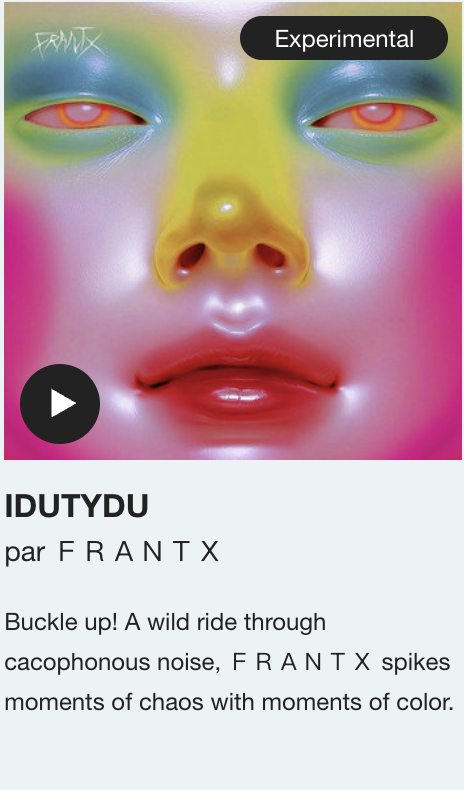
Buckle up! A wild ride though cacophonous noise, F R A N T X spikes moments of chaos with moments of color.
idutydu,
f r a n t x
— chronique
—
par Selma Namata Doyen
photo © Eudes Lemare
line-up
—
Fanny Meteier tuba, voix, toy synth
Andrea Giordano voix, électronique, mélodica
Pierre Pradier guitares, voix
Marco Luparia batterie, électronique, voix
carton records
standard in-fi
mai 2026
—
Le titre est déjà un petit accident administratif : IDUTYDU (I Didn’t Understand That You Didn’t Understand). On pourrait croire à un échange de mails devenu incontrôlable ou à un bug de sous-titres automatiques. En réalité, c’est un résumé assez exact du disque : une musique où les informations arrivent trop vite, changent de fonction en cours de route, puis reviennent déguisées comme si de rien n’était.
Chez FRANTX, les instruments n’ont manifestement pas signé pour les postes qu’on leur avait promis. Le tuba ne sonne presque jamais tuba : il souffle, compresse, parasite, gonfle les contours du son jusqu’à ressembler tantôt à un moteur fatigué, tantôt à une nappe électronique qui aurait mangé trop de gravier. La batterie ne marque pas le temps, elle le découpe en tranches inégales et les redistribue sans prévenir. Les guitares choisissent de ne pas choisir entre riff, texture, objet contondant et meuble sonore. Quant aux voix, elles circulent dans le mix comme des personnages secondaires qui auraient pris le contrôle du scénario. Le plus amusant, c’est que cette organisation apparemment anarchique est d’une précision presque vexante. Les morceaux tiennent par gestion des densités, déplacements de registres, ruptures calibrées et un travail très fin sur la saturation. Rien ne déborde par accident.
PINGU TRAUMA avance comme 4 membres d’un groupe qui se chamailleraient en jouant, tout en restant étonnamment d’accord. ORGASMIC KITCHEN pousse encore plus loin cette économie du faux chaos : motifs abandonnés, retours absurdes, coupes sèches, puis soudain un passage parfaitement construit — comme si quelqu’un avait rangé le bazar pendant qu’on regardait ailleurs Et puis il y a BANANA PHONE BOI, qui étire enfin le temps. Les couches s’empilent : souffles, saturation, électronique, voix, percussion, timbres qui se frottent sans politesse excessive. Là, le disque révèle son vrai talent : produire énormément de matière sans jamais fabriquer de bouillie.
IDUTYDU pourrait donner parfois l’impression qu’un ensemble de musique contemporaine aurait accidentellement surfé sur trop de forums, téléchargé trop de pop et avalé un peu trop de caféine. Trop ? Définitivement non. Ce disque groove souvent et jamais trop. Avec beaucoup plus de tenue qu’on pourrait lui en accorder.
Banlieues Bleues trace de nouveaux chemins
Le 31 mars, à la Dynamo de Pantin, Banlieues Bleues ouvrait une soirée placée sous le signe du risque et de l’invention avec TERRINE, FRANTX et Rojin Sharafi. Trois propositions pour « tracer de nouveaux chemins », lisait-on dans l’édito du festival, et c’est bien cette ligne qui a dessiné la soirée, faite de tensions, de matières instables et de formes qui refusent de se laisser domestiquer.
[…]
FRANTX allait ensuite déplacer la soirée vers un autre type de tension, plus vocale, plus politique, plus fragmentée aussi. Le quatuor franco-italien donne à voir un monde en crise, tantôt hostile, tantôt désespéré ou absurde : Fanny Meteier en keffieh donne le ton avec un discours engagé, Andrea Giordano prend le relais, masquée par un carré dentelé, voix distordue jusqu’à devenir presque sans visage, mais jamais totalement déshumanisée. Le groupe, né de croisements entre improvisation, musique concrète, pop mutante et noise-glitch, travaille le collage comme une dramaturgie du heurt.
La musique avance par à-coups, par surgissements, par motifs qui se défont aussitôt qu’ils se stabilisent. On passe du coq à l’âne, mais sans gratuité : cette instabilité semble constitutive du projet, comme si chaque musicien testait en permanence la résistance du groupe, ses limites de cohésion, ses seuils de chaos. Certaines séquences, notamment celles qui jouent sur les aigus de la guitare et des clochettes dans des textures micropolyphoniques où se répondent Pierre Pradier et Marco Luparia, ouvrent de très beaux espaces de suspension.
Et puis l’humour, indispensable antidote pour ce monde cassé : « celle-là, c’est la chanson du camping, je vous préviens », annonce la tubiste avant le dernier titre, en admettant son émotion à se présenter à Banlieues Bleues en tant que « fille du 93 ». Ce décalage entre la gravité du matériau et la simplicité du rapport au public donne au set une humanité particulière : « Fly Communication » fait sentir avec une lucidité ironique les malentendus et les tensions du collectif transnational comme partie intégrante de leur musique. C’est ce titre qui clôt leur premier album IDUTYDU, dont la sortie est prévue le 22 mai 2026.
[…]
Tatiana Paris – Thalle (Carton Records, 2025)
21 Maggio 2026
3–5 minuti
R E C E N S I O N E
Recensione di Luca Onyricon Giglio
Di ritorno dopo il suo esordio Gibbon del 2022, Tatiana Paris pubblica per la francese Carton Record il suo secondo lavoro Thalle e non presenta un disco, bensì una sorta di organismo vivente. Un organismo che tramite una fotosintesi mirata ci nutre liberando nell’aria architetture nebulose, sulle quali la musicista interviene. Piante senza radici né foglie, suggestioni dissonanti e organiche prendono vita dalla natura come corpi vegetali privi di tessuti vascolari complessi.
Alla vista di questa copertina, con reminiscenze a “Still Life” dei Van Der Graaf Generator, è il tallo a fungere da illustrazione, e in definitiva evoca la musica suonata da quest’artista, un album di dieci composizioni, intitolate senza lettere maiuscole, che si dispiegano senza soluzione di continuità in 45 minuti.
Un viaggio sorprendente, a tratti selvaggio, in cui Tatiana suona la chitarra preparata, accompagnata da sintetizzatori modulari, oggetti, un vecchio “acousmonium hertziano” (un vecchio flauto dolce), un organo e, occasionalmente, una voce eterea con autotune. Questa musica cinematografica sembra muoversi, fondersi con l’ambiente sottomarino. Si immaginano le piante ondeggiare al ritmo di una corrente liquida.
A comporre Thalle sono nove frammenti sonori che, analizzati al microscopio, svelano una struttura complessa e imprevedibile, il suo incedere oscilla fra strumentali cheti ed arrangiamenti acustico-rumoristi. Ricorda vagamente quell’onda magica e acustica che spesso accompagnava le uscite Tomlab, una sensibilità che di questi tempi si vede rifiorire anche nelle produzioni di aus e di Flau Records ad esempio, anche se qui, tramite il cantato, l’approccio vira in direzione di qualcosa di più intimo ed orecchiabile. I brani sembrano formarsi per genesi biologica, quasi come il corallo in copertina, molecola dopo molecola in forme e colori delicati. La chitarra boccheggia fra un respiro e l’altro, placida, a dare grumi di suono che a tratti potrebbero ricordare la magia dei Gastr Del Sol in trasparenza, quasi come se invece di spartiti Tatiana suonasse direttamente degli erbari, dando il via a piccoli caos appena percettibili, come minute forme di vita sotto il vetrino di un microscopio. A tratti la musica diventa solenne, soprattutto quando l’organo di Rachel Langlais fa da collante all’equilibrio elettroacustico a base di field recording, synth modulari, drone music, nastri registrati e oggetti casuali che producono suoni concreti.
Di tanta maestria e ingegno si nutrono i due capitoli drone ambient che prendono nome dal titolo dell’album, thalle I e thalle II, dove la magia si fa ieratica e immobile, quasi ci costringesse a cercarne una presenza con lo sguardo oltre che con l’udito. Il ritorno della voce nella conclusiva salluit e l’apparente contrasto armonico di avril sono due facce della stessa medaglia (tutti gli interventi vocali sono tratti da poemi di Pierrick Pagé, Joséphine Bacon e Marie Andrée Gill), un commiato crepitante e misterioso, un breve attimo di crescita e di luce condivisa fra esseri in continua evoluzione e cambiamento, un miscuglio di sperimentazione e consapevolezza tecnica che anima tutta l’opera di Tatiana Paris e che in Thalle trova la summa per una sintesi sottrattiva ammirevole.
Carton Records ha il potere di attrarci con l’ignoto, attraverso il prisma di audaci avventure musicali. Ad ogni uscita, ci ritroviamo talvolta immersi nel mondo minerale o travolti dai meandri di qualcosa di più organico. Con Thalle si raggiunge una sorta di apogeo, un’opera unica e immutabile, capace di trascinarci in un disagio sensuale sonoro (intro) che funge sia da esca sia, soprattutto, da processione verso un altare ricoperto da questo tallo, che si dispiega con un distacco quasi soprannaturale. Abbondante e pervasiva, la musica traccia un percorso di eccellenza, liberandosi dai sentieri battuti per trasmettere al meglio ciò che l’evanescenza può produrre quando non è la radice della futilità.
Thalle è la perfetta traduzione musicale della parola emozione, una ballata senza tempo, un tuffo in ciò che non possiamo immaginare, una frontiera che risponde alla possibilità che l’infinito possa avere una fine. Tra paesaggi sonori e rumori maestosi che offrono evasione, Thalle è un volo commovente, quasi mistico, eppure saldamente radicato alla terra, con radici che si protendono verso il cielo vaporizzandosi in una bellezza straordinaria.
Music: Wiggly Air – Deafkids, My Heart, An Inverted Flame, it foot, it ears, FRANTX, Tom Waits and Massive Attack
Electro blipmares from Paris. The French/Italian four-piece FRANTX sound decidedly more contemporary than does it foot, it ears, but are similarly disorienting, likely because I don’t speak French. They’re super-cute and vaguely anxious, technicolor techno masking what seems to be a disaffected detachment. All four members provide (processed) vocals and synth textures on their debut IDUTYDU (LP, download from Carton Records May 22), although there’s also occasional acoustic guitar and tuba as well. A slow chaos ensues, as on “Pingu Trauma,” in which a robot sing-a-long interrupts what sounds like a cartoon ensconced in a blanket of scorn. There are little melodies at times, but there’s not often much going on in song form. Still, it manages to keep a poppish feel aloft, like comic sans illbient. The lyrics might point a different direction, but that said, the album’s final track, “Fly Communication,” delivered in accented English, is about our inability to converse with bugs, even when they say they understand. Communication is overrated.